
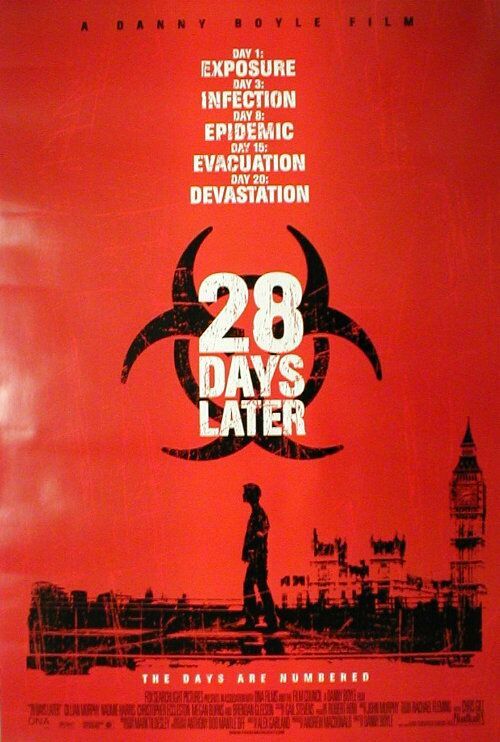
What the Film Is About
“28 Days Later” is a haunting exploration of survival and transformation set against the aftermath of a society-shattering epidemic. At its core, the film traces the journeys of ordinary people forced to navigate a world stripped of stability, civility, and hope. The central conflict revolves around the struggle not just to survive physically, but to retain one’s humanity in a reality defined by violence and moral collapse. Emotional resonance emerges through the characters’ fear, desperation, fleeting tenderness, and the unsettling choices they confront as familiar social order dissolves. The narrative moves inexorably from isolation toward a redefinition of community, testing the boundaries of loyalty, trust, and identity in a world where the known rules no longer apply.
Rather than just recounting a viral outbreak, “28 Days Later” interrogates how catastrophe exposes the limits of civilization and the capacity for both brutality and compassion. The ensuing journey is as much internal and existential as it is external, questioning what persists of the human spirit amid ruin and threat. The film compels viewers to weigh the consequences of fear and survival when stripped of institutional safeguards, asking what, if anything, can be rebuilt from ashes.
Core Themes
One of the film’s most prominent themes is the fragility of civilization. “28 Days Later” presents a world where systems of law, order, and community have evaporated overnight, stripping humanity back to its rawest instincts. The narrative explores how quickly the veneer of civility can disintegrate, exposing darker impulses beneath. This theme resonated deeply in the early 2000s, an era marked by anxieties about terrorism, evolving epidemics, and the reliability of social structures. Even today, the film’s questioning of societal stability and the fine line between order and chaos remains urgent and relevant, especially in light of recent global crises.
Closely tied to this is the examination of morality under pressure. The characters are repeatedly forced to confront stark moral dilemmas in an environment where previous codes may no longer apply. The story asks: What are we willing to do to survive? How does compassion or cruelty emerge when rules disappear? As characters oscillate between ethical and primal behaviors, the film interrogates the limits of empathy and the potential for both heroism and savagery inherent in us all.
Identity and transformation also loom large as themes. The crisis interrupts and erases people’s former roles and social markers, compelling each character to redefine themselves. The protagonists must reconstruct meaning amid chaos, grappling with loss and forming new bonds. In doing so, the film suggests that identity is not fixed, but forged and reforged by circumstance.
Moreover, the idea of hope versus nihilism courses throughout. “28 Days Later” repeatedly teeters on the brink between despair and optimism: is humanity doomed to self-destruction, or can something meaningful be reclaimed? The possibility of rebirth and redemption—after overwhelming devastation—is both haunted and tentatively celebrated by the film’s conclusion.
Symbolism & Motifs
The film’s imagery abounds in symbols and motifs that deepen its exploration of post-apocalyptic existence. Perhaps the most striking is the use of empty urban spaces—especially the deserted streets of London. These stark vistas evoke a haunting sense of loss and underscore the sudden absence of human connection and routine. The emptiness of once-bustling places symbolizes the existential void left by societal collapse.
Another powerful motif is that of the infected, who are defined by unrestrained rage rather than traditional zombification. Their mindless violence operates as a symbolic extreme of unchecked aggression, mirroring the potential within humans themselves when stripped of rules and reason. This deliberate contrast between the infected and the survivors blurs the lines between “monster” and “man,” suggesting that anyone can be overtaken by rage or despair under the right circumstances.
Blood and contagion serve as recurring visual and narrative symbols—representing both literal and metaphorical infection. The transmission of the virus is fast and merciless, highlighting how quickly society’s ills can spread and overwhelm. Yet the theme of contagion extends beyond biology to critique how violence, fear, and savagery can be just as infectious within human communities.
Nature’s gradual reclamation of urban spaces provides a quieter but resonant motif, signaling both decay and the possibility of new beginnings. Overgrown gardens and wild animals in abandoned places point to a natural world indifferent to humanity’s fate, yet also to the chance of renewal beyond collapse. This duality reinforces the film’s tension between despair and hope.
Key Scenes
Key Scene 1
A pivotal early moment occurs when the protagonist first awakens alone in a ravaged hospital and emerges into an empty London. This scene’s emotional power stems from its unnerving silence and stark visual contrast: a world once crowded and choreographed now stilled and hostile. The emptiness is not simply physical; it reflects the psychological dislocation of the survivor and the radical vulnerability brought by the collapse of collective life. This scene crystallizes the film’s horror—not simply of monsters, but of lost belonging and the abrupt end of shared meaning. It sets the tone for all that follows: isolation, confusion, and a profound sense of being unmoored.
Key Scene 2
Another crucial sequence unfolds when the survivors encounter a supposed sanctuary—a military outpost promising safety. Rather than refuge, they find a different kind of threat, as some soldiers resort to cruelty and domination to impose order and satiate their own desires. This confrontation sharply interrogates the theme of morality under duress. The breakdown of official authority gives rise to new, self-appointed power structures that can be as predatory as the infected outside. This scene forces both the characters and the audience to confront uncomfortable questions about what people will justify or rationalize when survival hangs in the balance. It lays bare the film’s contention that the most dangerous threats may come from within, not from monstrous others.
Key Scene 3
A third turning point arrives in a climax where the main character, transformed by trauma and necessity, exhibits an almost feral violence to rescue his companions. The distinction between human and infected blurs as survival demands drastic action. Symbolically, this moment captures the film’s central interrogation of identity and humanity: is survival at any cost worth the price? Yet, the aftermath introduces a possibility of restoration, as glimmers of empathy and connection re-emerge. In this way, the scene serves not only as a narrative climax but as a reflection on what it means to reclaim one’s humanity after descending into darkness. The film ultimately holds out a slim but vital hope that, even after horror and moral collapse, the capacity for redemption remains.
Common Interpretations
“28 Days Later” has sparked a range of interpretations among critics and viewers. Many see it as a parable about the fragility of civilization, with the viral outbreak functioning as a metaphor for social breakdown, the spread of violence, and the precariousness of community. Some readings emphasize the film’s critique of militarism and toxic masculinity, highlighting how those supposedly entrusted with authority can perpetuate harm when unaccountable.
Others interpret the film as an existential meditation on loss and rebirth, where apocalypse becomes a test of identity and values rather than merely an external disaster. There is also a strand of ecological interpretation, noting the symbolism of nature reclaiming human-built environments and the possibility of renewal after devastation. More psychologically, the infected are seen as embodiments of unrestrained rage and fear, personifying the emotional contagions that can overwhelm societies, especially under stress.
Nonetheless, the majority of analysts agree that “28 Days Later” is less concerned with traditional horror or action and more intensely focused on what it means to remain—or reclaim—human in the face of unimaginable threat. The persistent ambiguity of its hope and despair is widely cited as key to its enduring power.
Films with Similar Themes
- Children of Men (2006) – Shares the exploration of societal collapse, the loss of hope, and the search for meaning in a world stripped of order.
- The Road (2009) – Grapples with moral choices and human bonds amid post-apocalyptic devastation, focusing on survival and father-son connection.
- Dawn of the Dead (1978) – Investigates the breakdown of social systems and humanity’s response to crisis, using the zombie outbreak as metaphor for societal malaise.
- The Mist (2007) – Foregrounds paranoia, moral conflict, and the dangers of groupthink when ordinary people are thrust into a survival scenario.
In conclusion, “28 Days Later” delivers a sobering meditation on the endurance—and limits—of humanity when confronted by catastrophic loss and fear. It interrogates not only the nature of external threats, but the peril and possibility residing within individuals and societies themselves. By unraveling the constructs we take for granted, the film both reflects anxieties of its own era and speaks robustly to any age wrestling with uncertainty. Its ultimate message is both warning and consolation: while collapse can reveal the worst in us, it also offers the painful, persistent chance to reclaim what is best.
🎬 Check out today's best-selling movies on Amazon!
View Deals on Amazon