
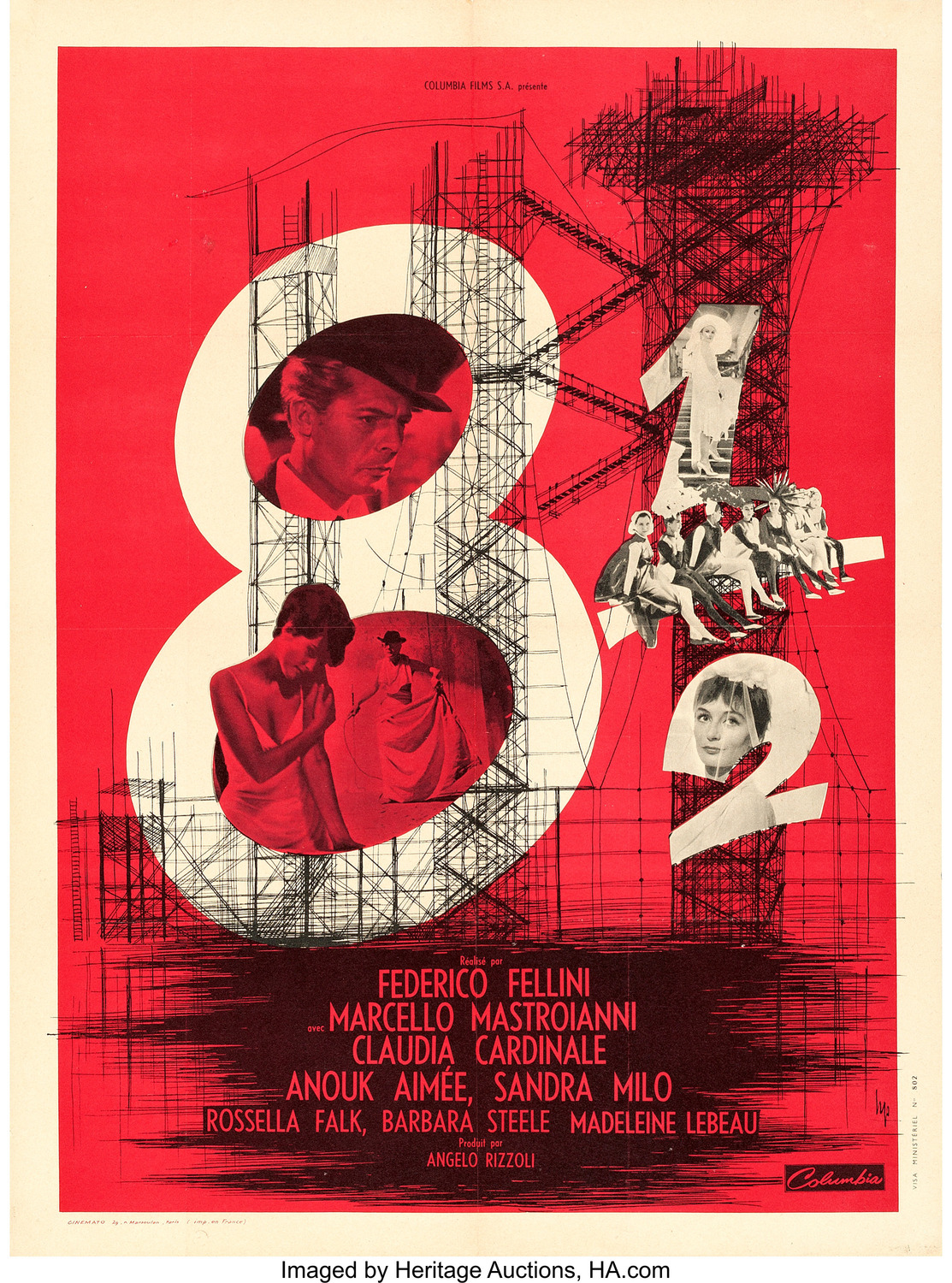
What the Film Is About
“8½,” directed by Federico Fellini and released in 1963, is an imaginative, introspective exploration of artistic paralysis, personal doubt, and the search for meaning. The narrative centers on Guido Anselmi, a successful film director who, faced with mounting creative and personal pressures, finds himself unable to move forward with his next project. Rather than unfolding as a linear chronicle, the film manifests Guido’s internal landscape—blurring lines between memory, fantasy, and reality as he wrestles with questions about his life, his career, and his relationships.
On an emotional level, “8½” is both playful and poignant. Guido’s journey is marked by alienation and fragmentation; surrounded by admirers, colleagues, and lovers, he nevertheless cannot find peace with himself. The film invites the audience into a deeply subjective experience, depicting the chaos of the creative mind while probing the costs and contradictions of pursuing one’s true intentions in both art and life.
Core Themes
“8½” is fundamentally an examination of the creative process—its joys, torments, and inherent ambiguities. The central theme is artistic identity: Guido’s struggles are not simply about making a film, but about reconciling who he is as an artist, a man, and a public figure. The film interrogates authenticity versus role-playing, showing Guido torn between external expectations and his private longings.
Other major themes include memory and self-reflection; Guido retreats into images from his childhood and past relationships, seeking answers in recollection. There’s an ongoing dialogue about the impossibility of total self-knowledge, as well as the gap between intention and execution—especially poignant during a period (the early 1960s) when filmmakers and artists were increasingly questioning their role in society.
The film’s explorations of masculinity, desire, and escapism are also vital, as Guido’s interactions with women reflect his uncertainty about love, fidelity, and the nature of fulfillment. Such themes resonated deeply during a time when traditional social structures were beginning to unravel; they continue to matter as they speak to contemporary anxieties about identity, creative purpose, and the elusive nature of satisfaction.
Symbolism & Motifs
“8½” is renowned for its rich tapestry of symbols and recurring motifs, each contributing to the film’s multilayered meditation on art and selfhood. One of the most memorable symbols is the circular motif, including the film’s title itself, which refers to the number of films Fellini had previously directed. This motif appears visually in the film’s dance sequences and the carousel-like camera movements, suggesting cycles of repetition, inescapable patterns in life and art, and the desire for closure or escape.
Another potent symbol is the spaceship set that haunts Guido—a massive, incomplete construction for his film-within-the-film. This set, both concrete and absurd, becomes a metaphor for grand ambitions that are never realized, as well as the paralyzing fear of failure.
Light and darkness are frequently juxtaposed, not only in the black-and-white cinematography but within scenes that blend waking life, memory, and dream. Light often symbolizes revelation, inspiration, or the intrusion of reality; darkness, by contrast, embodies mystery, introspection, and the unknown.
Water recurs as a motif, associated with the unconscious, baptism, and rebirth; scenes by baths or fountains point to moments of renewal or the desire for purification. Similarly, women themselves become motifs—representing not just romantic or sexual longing but lost innocence, unattainable ideals, and the multifaceted nature of inspiration.
Key Scenes
Key Scene 1
A pivotal early scene depicts Guido trapped in a traffic jam, followed by a surreal fantasy of floating above the city and then being pulled back to earth. This moment is crucial because it visualizes the sensation of suffocation and escape—the tension between the demands pressing in on Guido and his yearning to transcend them. The sequence’s dreamlike quality establishes the film’s defining approach: reality and imagination are inseparable, and both are required for self-understanding. The floating dream powerfully summarizes Guido’s simultaneous longing for liberation and his inability to break free from his obligations.
Key Scene 2
A later scene features Guido surrounded by all the women in his life, in a fantasy reminiscent of a harem. Far from a simple wish-fulfillment, the sequence is deeply self-critical; the pageantry and playfulness eventually collapse into chaos and rebellion, exposing the limits of Guido’s control and the exhaustion of his desires. The scene deftly interrogates the notion of the “muse,” revealing how projected fantasies distort real human connection and ultimately leave the artist isolated.
Key Scene 3
The film culminates in the astonishing final scene, where Guido, having abandoned his film, imagines a circus ring in which all the characters—including his colleagues, lovers, friends, and even himself as a child—join in a dance. This metaphorical gathering is not a triumph but an acceptance: Guido recognizes the impossibility of perfect synthesis in art or life, yet finds a kind of peace in embracing the multiplicity of his experiences. The carousel of characters and the circular dance signal the film’s ultimate message—meaning is made not through resolution, but through embracing ambiguity and the interconnectedness of one’s contradictions.
Common Interpretations
Critical and popular interpretations of “8½” have long centered on the film as a self-referential exploration of artistic crisis. Many view it as Fellini’s coded confession—a film about being unable to make a film, turning personal creative blockage into the very subject of creation. Some critics emphasize the universality of Guido’s struggle, seeing it as a meditation on the human need for meaning in a world that resists easy answers.
Others have highlighted its gender dynamics and the problematic ways desire and inspiration are shaped by male fantasy, suggesting the film grapples—sometimes uncomfortably—with masculine projections and the limits of the male gaze. Psychological readings focus on the division of Guido’s psyche, interpreting his journey as an inward confrontation with unresolved aspects of his past and present.
Many audiences, meanwhile, simply appreciate the film’s exuberant style, humor, and freedom from conventional storytelling, interpreting “8½” as a celebration of the creative imagination and the value of artistic experimentation.
Films with Similar Themes
- La Dolce Vita – Shares Fellini’s fascination with existential weariness, the search for meaning amid sensory excess, and the burdens of modernity.
- All That Jazz – Explores the life of a tormented artist whose creativity is entwined with self-destruction and personal chaos.
- Nostalgia – Examines themes of memory, alienation, and the quest for authenticity within an artist’s journey.
- Barton Fink – Reflects on the pressures of the creative process and the surreal, often nightmarish experience of artistic paralysis.
Ultimately, “8½” communicates that both art and life are filled with irresolvable contradictions, partial truths, and momentary revelations. The film argues that to be human is to continually negotiate between fantasy and reality, the individual and the collective, ambition and limitation. By making process itself—doubt, confusion, fleeting insight—the heart of his work, Fellini honors the mystery and struggle of searching for meaning. In an era poised between tradition and modernity, “8½” continues to resonate as a luminous reflection on the restless pursuit of authenticity, both in art and in everyday existence.
🎬 Check out today's best-selling movies on Amazon!
View Deals on Amazon