
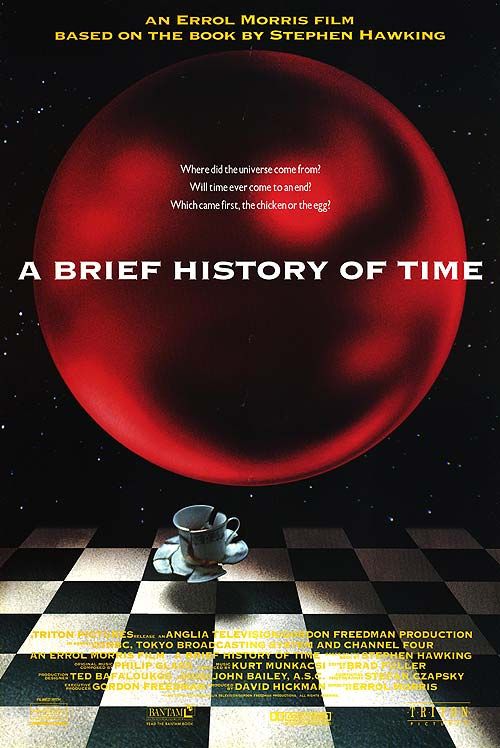
What the Film Is About
“A Brief History of Time” (1991), directed by Errol Morris and inspired by Stephen Hawking’s influential book, is not a conventional biography or a linear scientific documentary. Instead, it’s a contemplative and poetic exploration of Hawking’s revolutionary ideas in cosmology, intertwined with the personal rhythms of his extraordinary life. The film traces Hawking’s search to understand the origins and fate of the universe, as well as his battle with physical limitations imposed by ALS. The emotional journey is one of wonder, resilience, and the relentless human drive to uncover the deepest truths of existence, despite daunting personal and cosmic obstacles.
At its heart, the film oscillates between the vast impersonal logic of the universe and the intimate, vulnerable realities of life. The central conflict revolves around humanity’s attempt to find meaning and order amidst chaos, and Hawking’s own heroic determination to communicate this quest. The narrative is driven less by events and more by the gradual convergence of personal testimony and philosophical inquiry—blurring the lines between scientific fascination and existential awe.
Core Themes
One of the film’s principal themes is the human capacity for curiosity and perseverance in the face of apparent insignificance. By juxtaposing the enormity of the universe with the fragility of Hawking’s body, the film foregrounds an essential tension: the search for knowledge versus the limitations of human experience. This is a meditation not just on scientific discovery, but on the paradox of intellect residing within a vulnerable form—the triumph of mind over matter.
Another key theme is the nature of time itself: its linearity, its possible origins and endings, and its psychic weight on the individual. The film probes philosophical questions about existence—why we are here, whether the universe had a beginning, and what the boundaries of knowledge might be—all filtered through Hawking’s dry wit and unblinking clarity.
Upon its release in 1991, the film resonated with a world on the brink of a new millennium, anxious about technological change and the limits of human understanding. Its themes remain relevant today, as we still grapple with existential uncertainty, the advancement of science, and the enduring need for hope and meaning in a universe that often seems indifferent.
Symbolism & Motifs
The film deftly uses recurring motifs to reinforce its underlying ideas. The motif of clocks and ticking mechanisms pervades the visual landscape, symbolizing the passage of time and humanity’s attempt to measure and master it. These images, set against Hawking’s meditations on the nature of time, serve as a silent counterpoint to the vastness and intangibility of cosmic history.
Another potent symbol is the blackboard, covered with arcane equations. It stands for both the beauty and the inscrutability of scientific thought—the blackboard is a liminal space where abstract ideas become concrete, a window into Hawking’s mind. The juxtaposition of family photographs with shots of interstellar objects creates a motif of scale, visually echoing the tension between the personal and the cosmic.
Interviews with family, friends, and colleagues are woven into Morris’s signature visual collages, which juxtapose mundane daily details with awe-inspiring concepts. This pattern underlines the connection between universal mystery and everyday perseverance. The film’s sound design—using Philip Glass’s minimalist score—enhances the sense of time looping, stretching, and folding back on itself, echoing central cosmological ideas.
Key Scenes
Key Scene 1
A crucial scene features Stephen Hawking’s mother recounting his childhood curiosity and early interest in the stars. The emotional weight of this moment lies not just in familial affection, but in the idea that Hawking’s quest for understanding began long before physical symptoms of ALS appeared. Here, the film distills its message: profound, world-altering curiosity can arise from the most ordinary origins, challenging the notion that genius is an isolated phenomenon divorced from daily life.
Key Scene 2
Another significant scene shows Hawking’s colleagues and nurses reflecting on his stubborn refusal to acquiesce to his illness. Through their testimonies, the film blurs the boundary between personal struggle and impersonal scientific pursuit. This convergence reinforces the film’s core theme: that the drive to understand the universe is inseparable from the drive to persist, to overcome obstacles, and to communicate meaning across seemingly insurmountable barriers.
Key Scene 3
Toward the film’s culmination, Hawking discusses the search for a unified theory—a moment that functions as both a scientific and existential turning point. This is less about the details of physics and more about the universal longing for order, explanation, and coherence in the face of cosmic uncertainty. It serves as the film’s final statement: the act of asking questions, not just the answers, gives coherence to both the universe and our lives. Here, intellectual humility and hope merge, inviting viewers to share in the wonder and humility that true knowledge requires.
Common Interpretations
Critics and audiences often interpret “A Brief History of Time” as a meditation on the resilience of the human spirit. One of the most widely accepted interpretations is that the film’s real subject is not merely the cosmos, but the act of questioning itself—the relentless curiosity that defines both Hawking and, by extension, all humanity. Hawking embodies the paradox of intellectual greatness within a physically constrained body, an image that many have seen as emblematic of the broader human condition.
Some viewers emphasize the film’s treatment of scientific discovery as an emotional and philosophical journey, as much about confronting uncertainty as it is about technical progress. Others focus on the film’s intimate portrait of Hawking, seeing it as a testament to the power of community and collaboration in the face of adversity. While most interpretations celebrate the fusion of scientific and personal narratives, a few critics have noted the film’s subtle questioning of whether ultimate knowledge is ever truly attainable—or if, instead, the pursuit itself is what gives life meaning.
Films with Similar Themes
- Cosmos (1980) – This documentary series by Carl Sagan shares the theme of bridging personal wonder with the vastness of the universe, inviting viewers to contemplate humanity’s place in the cosmos.
- Einstein and Eddington (2008) – This film explores the intellectual struggles and collaborations behind groundbreaking scientific theories, echoing the partnership and perseverance seen in Hawking’s life and work.
- The Theory of Everything (2014) – A biographical drama about Stephen Hawking, addressing similar themes of perseverance, love, and the pursuit of scientific truth amid personal challenges.
- Contact (1997) – Adapted from Carl Sagan’s novel, this film also investigates humanity’s longing to connect with the infinite and to reconcile scientific wonder with deep philosophical questions.
In conclusion, “A Brief History of Time” ultimately communicates that the drive to understand—whether of the universe or ourselves—is a fundamental part of what it means to be human. Through its intertwining of scientific, personal, and philosophical threads, the film celebrates curiosity and resilience, portraying knowledge not as a distant or abstract goal, but as a profoundly human journey marked by humility, community, and wonder. If the universe is vast and mysterious, so too is the inner landscape of inquiry, hope, and persistence that defines every era and every human life.
🎬 Check out today's best-selling movies on Amazon!
View Deals on Amazon