
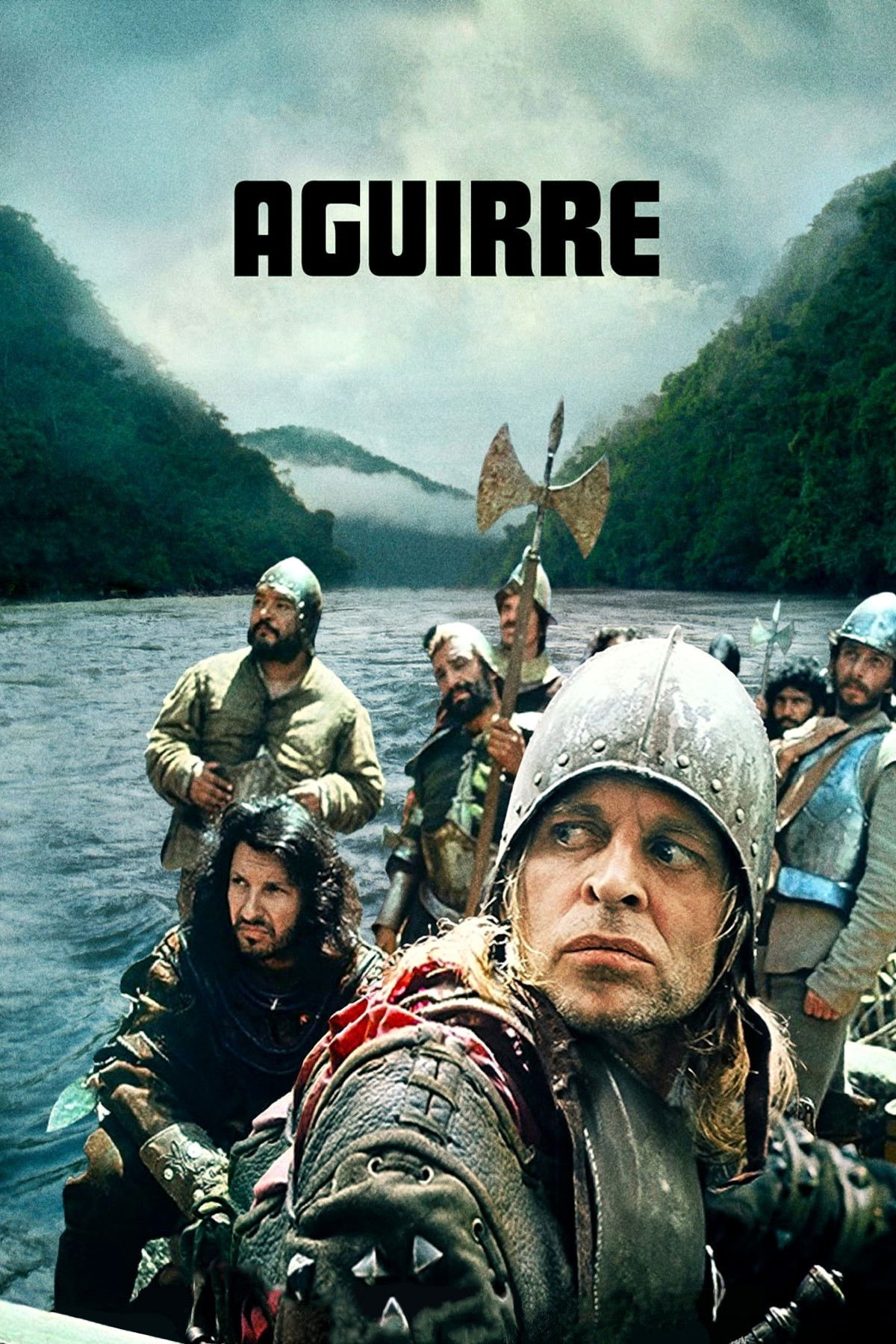
What the Film Is About
“Aguirre, the Wrath of God,” directed by Werner Herzog in 1972, follows a doomed expedition of Spanish conquistadors and their native allies as they descend into madness in search of El Dorado, the mythical City of Gold. At its core, the film is less a historical retelling than an existential journey through obsession and delusion, embodied by its enigmatic protagonist, Don Lope de Aguirre. Emotional tension grows relentlessly as the expedition unravels, plunging the group into chaos, paranoia, and violence. The film works as a portrait of ambition pushed to the edge, stripping civilization down to its most primal instincts and exposing the fragility of leadership, belief, and sanity.
Herzog’s film is infused with a haunting atmosphere that blurs reality and hallucination. Instead of a traditional narrative arc, the story confronts viewers with the gradual psychological disintegration of both the leader and his followers, displaying the overwhelming force of nature and the limits of human ambition. The film continually challenges audiences to contemplate what drives a person, or society, to destruction in the relentless quest for power and meaning.
Core Themes
The heart of “Aguirre, the Wrath of God” lies in its exploration of power, madness, and the collision between humanity and nature. The film dissects the corrupting influence of absolute ambition, as Aguirre’s megalomania escalates amid the inhospitable Amazon. Herzog uses the jungle not simply as a setting, but as a living metaphor for unpredictability, chaos, and indifference to human desire. The conquistadors’ quest for glory becomes a study in moral decay; detached from civilization, their values erode until only raw force and delusion remain.
Another enduring theme is the futility of conquest—how dreams of domination and immortality unravel in the face of overwhelming natural power. The film’s anti-hero doesn’t just defy authority; he seeks to become it, obsessed with leaving his mark on history even as reality slips away. The group’s descent mirrors the wider consequences of colonial ambition, laying bare the violence and blindness that often accompany the drive to control and possess. When it was released in the early 1970s, these reflections spoke directly to anxieties over authority, the aftermath of colonialism, and the environmental and psychological costs of unchecked expansion. Today, the film’s core questions—about the cost of ambition and humans’ place in the natural world—remain as pressing and universal as ever.
Symbolism & Motifs
Herzog’s approach to visual storytelling relies heavily on persistent symbols and motifs to evoke meaning. The river is perhaps the film’s most potent symbol—its endless, meandering path stands for fate, time, and the unstoppable current of history. As the raft drifts deeper into the Amazon, characters become increasingly powerless, subject to nature’s whims more than their own plans. The raft itself, precarious and ever-splintering, embodies the illusion of control and the fragility of civilization.
Physical and psychological decay is another recurring motif. The conquistadors’ elaborate armor and pageantry deteriorate alongside their hierarchy and discipline, illustrating the impossibility of imposing order in an indifferent wilderness. Aguirre’s physical isolation from the group mirrors his mental separation and growing obsession. The jungle, filmed in long, enveloping takes, is portrayed as both beautiful and menacing—a space that absorbs and erases those who challenge it. This motif of engulfment recurs in the way the camera lingers on mist, tangled branches, and the endless river, constructing an environment that is as much a character as any human in the story.
The monkeys that swarm the raft near the film’s end serve as an unsettling symbol of nature’s reclaiming force and the final breakdown of rational order. Their presence suggests that efforts to dominate or civilize the world are ultimately futile—nature persists, indifferent to human ambition and folly.
Key Scenes
Key Scene 1
Early in the expedition, when the leaders pause to survey their surroundings, a formal hierarchy emerges. This moment is crucial for understanding the film’s vision of power and leadership. Despite the foreign, overwhelming environment, the group clings to order, ceremony, and ritual, desperately seeking meaning. The juxtaposition of regalia and mud hints at their vulnerability and the ultimately illusory nature of their authority. Emotionally, this scene establishes the fragility of both the expedition and the social structures that bind it, foreshadowing the unraveling that lies ahead.
Key Scene 2
Aguirre’s monologue as he asserts himself as the true leader, amid mounting chaos, distills the film’s central themes. In this speech, Aguirre openly rejects the authority of the Spanish Crown and the established hierarchy, crowning himself as “the wrath of God.” The moment is both a declaration of freedom and madness: his ambition transforms from a quest for riches to a delusional mission of domination. The camera’s focus on his fevered eyes and gaunt face conveys the consuming nature of obsession and shows how easily aspirations for power devolve into tyranny and isolation.
Key Scene 3
The film’s haunting final image—Aguirre alone on a raft, surrounded by dead crewmates and swarms of monkeys—encapsulates the ultimate meaning of the journey. Stripped of allies and reason, Aguirre rants about founding a new dynasty even as the jungle closes in. This scene is not simply a narrative endpoint, but a meditation on human hubris, loneliness, and the futility of conquest. It is a visual and thematic culmination, emphasizing that the pursuit of absolute power leads not to glory, but to delusion and annihilation.
Common Interpretations
Critics and audiences have consistently viewed “Aguirre, the Wrath of God” as a profound meditation on ambition, insanity, and the destructiveness of colonial dreams. One frequent interpretation sees Aguirre as an archetypal figure—the embodiment of unchecked power whose vision leads not to triumph, but to ruin. Many have argued that the film is less about historical events and more about the universal dangers of fanaticism.
Others read the film as an allegory for the collapse of authority and the lure of utopian visions, reflecting contemporary concerns of the 1970s. The breakdown of order in the jungle mirrors social and political upheaval in the modern world. Some viewers focus on the environmental themes, regarding the impassive and overwhelming jungle as a commentary on humanity’s arrogance in the face of nature’s permanence. Most agree that Herzog’s ambiguous style leaves room for multiple readings, but the prevailing sentiment is that the film offers a bleak diagnosis of human striving and a cautionary tale about overreaching ambition.
Films with Similar Themes
- Apocalypse Now (1979) – Both films probe the madness that emerges when men pursue conquest and power in an alien environment, drawing heavily on the motif of the river as a journey into the heart of darkness.
- Fitzcarraldo (1982) – Another Herzog film, it shares Aguirre’s focus on obsession, the struggle against nature, and the cost of visionary ambition turned destructive.
- The Mission (1986) – Like Aguirre, this film engages with themes of colonialism, cultural encounter, and moral conflict in the South American wilderness.
- The Lost City of Z (2016) – This film follows explorers whose dreams and ambitions are tested by an unforgiving jungle, echoing Aguirre’s central meditation on obsession and the limits of human endeavor.
In sum, “Aguirre, the Wrath of God” stands as a singular meditation on the folly of ambition and the savagery that can emerge when human beings attempt to impose their will on the world. It interrogates the essence of leadership, the allure of power, and the unavoidable truth that nature will always outlast the dreams and delusions of those who seek to conquer it. Herzog’s ambiguous and hypnotic vision continues to challenge audiences to reflect on the boundaries between civilization and chaos—and what it means to chase glory at the cost of one’s soul.
🎬 Check out today's best-selling movies on Amazon!
View Deals on Amazon