
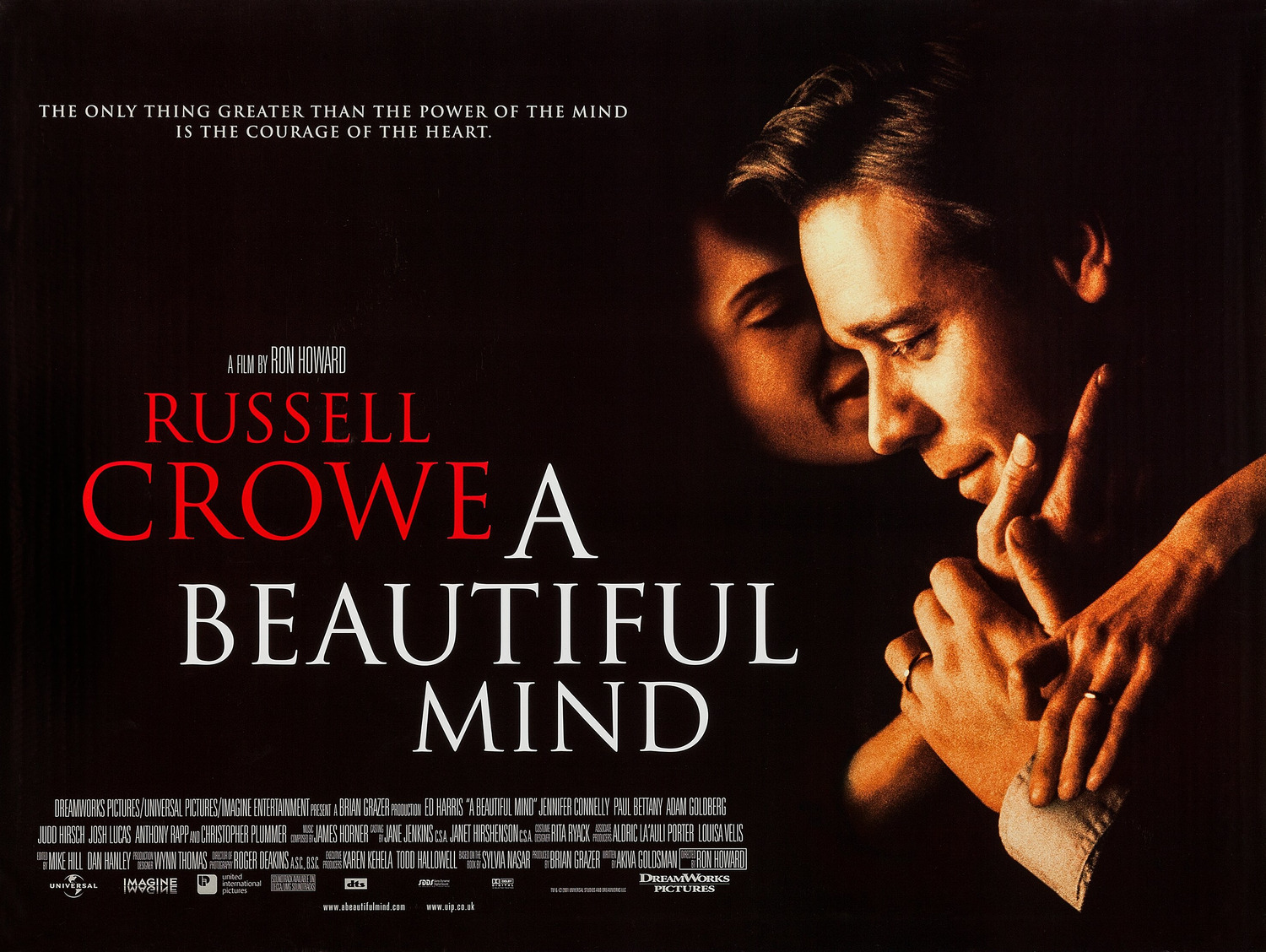
What the Film Is About
“A Beautiful Mind” (2001) is ultimately a film about the triumphs and torments of a gifted intellect wrestling with the invisible adversary of mental illness. While rooted in the world of academia and mathematical genius, the narrative transcends the specifics of John Nash’s individual story to probe universal questions of perception, reality, and isolation. The film tracks Nash’s emotional journey as he ascends from promising young scholar to Nobel laureate, while fighting a devastating internal war against paranoid schizophrenia. The central conflict is not simply between protagonist and society, but between a brilliant mind and its own limitations—between the truths we perceive and the truths that actually are. It is a journey of striving for connection and clarity in the midst of personal tumult, underscoring the evolving dynamic between genius, vulnerability, and acceptance.
On a deeper level, “A Beautiful Mind” explores the painful process of confronting one’s own mind and learning to trust others. The narrative direction moves beyond a story of academic achievement, becoming a quiet meditation on the acts of perseverance, love, and persistence required to confront inner demons. It is a film about finding meaning, belonging, and reconciliation—not just with society, but within oneself.
Core Themes
The core themes of “A Beautiful Mind” revolve around perception versus reality, the isolating effects of mental illness, the redemptive power of love, and the struggle for self-acceptance. At its heart, the film explores the idea that genius and madness are often separated by only the thinnest of boundaries. Nash’s pioneering intellect is juxtaposed with his inability to trust the evidence of his senses, raising questions about the nature of truth and the reliability of human perception.
Mental illness is depicted not as a distant dysfunction, but as an intensely lonely journey—one that can threaten to eclipse both accomplishment and connection. The film does not reduce Nash’s struggle to clinical terms but immerses the audience in his disorienting subjectivity, destabilizing our faith in objective reality. This is where love plays its crucial part: Alicia, Nash’s wife, becomes the living embodiment of compassion, patience, and empathy. Her unwavering support underscores a theme that meaning and survival are intimately tied to human connection.
These themes were especially resonant at the turn of the millennium, a time when public discourse about mental health was beginning to shift toward acceptance and understanding, but stigmas remained. The film’s broader relevance lies in its enduring portrait of resilience—the capacity to carve a meaningful life from the fragmentary evidence of experience, even when the world refuses easy answers.
Symbolism & Motifs
“A Beautiful Mind” is filled with visual and narrative motifs that lend depth to its exploration of identity and perception. One of the most striking recurring symbols is the window—a barrier and a lens, both separating Nash from the world and framing his attempts to decode its patterns. Whether peering from his dorm room or through the glass of a lecture hall, these windows reflect his search for clarity but also his isolation.
Another motif is the act of deciphering codes and patterns. Nash’s compulsion to see connections, whether in newspapers or everyday occurrences, stands as metaphor for the human desire to impose logic on chaos. This creative drive is both a source of his genius and a trigger for his illness, emphasizing the film’s ambiguity about the gifts and dangers of such vision.
The ever-present theme of mirrors and reflections is also important. These images frequently appear in moments when Nash questions his own reality—mirrors becoming a device for self-examination and the blurring of truth. The motif of numbers—scrawled across windows or arranged on chalkboards—serves as shorthand for the order he craves in a disordered world.
Contrasting with these visual symbols is the motif of the pen ceremony, where colleagues honor Nash by placing their pens before him. This ritual represents acceptance, belonging, and finally, recognition of his contributions by an academic community that initially could not understand his struggles.
Key Scenes
Key Scene 1
A pivotal early scene is Nash’s first major breakthrough in the Princeton bar, where he conceptualizes his original idea for mathematical equilibrium. This moment is crucial beyond its biographical significance; it is the instant when Nash’s inner world illuminates from disorder and uncertainty. Emotionally, it captures the exhilaration and loneliness of creative insight, as well as the inherent difficulty in communicating genius to others. It is not merely about intellectual accomplishment but about glimpsing a profound personal clarity amidst social alienation. This scene sets the standard for how the film equates mathematical discovery with the hope for meaningful human connection.
Key Scene 2
The climactic revelation where Nash comes to grips with the unreality of his delusions marks a profound turning point. Confronting the undeniable evidence that certain cherished relationships exist only in his mind, Nash wrestles with the collapse of his perceived reality. This is more than a plot twist; it is an existential reckoning with the fault lines between reason and madness, faith and evidence. The scene delicately explores the agony involved in realizing that your instincts and feelings—often our most trusted guides—can be fundamentally flawed. This painful self-discovery is at the heart of the film, illustrating the strength required not just to overcome illness, but to reconstruct a life around a fractured sense of self.
Key Scene 3
The Nobel Prize ceremony near the film’s end serves as both resolution and reflection. Here, Nash acknowledges his wife’s crucial role in his survival, recognizing the irreplaceable value of steadfast love. This powerful scene is not simply a celebration of professional achievement, but a moving statement of personal recovery. It confirms that, despite ongoing challenges, a meaningful life is possible through acceptance, humility, and connection. As Nash receives the pens from his peers, the act becomes a resounding affirmation: not just of intellectual prowess, but of redemption, communal support, and the enduring potential for hope.
Common Interpretations
Critics and audiences generally interpret “A Beautiful Mind” as a redemptive story about perseverance and the tenacity of the human spirit in the face of internal adversities. The film is widely praised for portraying schizophrenia with empathy and emotional depth, putting a human face on an often-misunderstood illness. Many see it as a testament to the power of love—that Alicia’s unwavering support is as pivotal to Nash’s success as any medication or institutional intervention. The story’s factual divergences have invited some debate, but the prevailing interpretation centers on themes of human dignity and compassion.
Another commonly discussed reading focuses on the boundary between genius and madness, and how society treats those who do not fit established norms. The film’s structure, placing the audience in Nash’s subjective experience, encourages viewers to question the solidity of reality itself—inviting comparisons between the order Nash seeks in mathematics and the messiness of actual life. Some have critiqued the film for its simplifications, but its emotional resonance has endured precisely because it speaks to the universal journey for acceptance, belonging, and self-understanding.
Films with Similar Themes
- Good Will Hunting (1997) – Both films explore intellectual brilliance tangled with emotional vulnerability and the quest for personal healing through relationships.
- A Beautiful Mind (2001) – Appropriately analyzed above, as it stands alone in blending mathematical genius with the inner struggle of mental illness and love.
- Shine (1996) – Examines the life of pianist David Helfgott, focusing on the intersection between extraordinary talent, mental illness, and the healing power of human connection.
- The Theory of Everything (2014) – Explores the life and challenges of physicist Stephen Hawking, balancing scientific genius with personal tribulations and the significance of unconditional support in the face of adversity.
Ultimately, “A Beautiful Mind” communicates the enduring truth that brilliance and struggle often coexist, and that true dignity is found not in the absence of hardship, but in the courage to confront it. The film reflects its early-2000s era in its depiction of scientific achievement as a public good, while moving toward a more nuanced understanding of mental health. Above all, it insists that recognizing the humanity—and beauty—in imperfection may be the most meaningful discovery of all.