
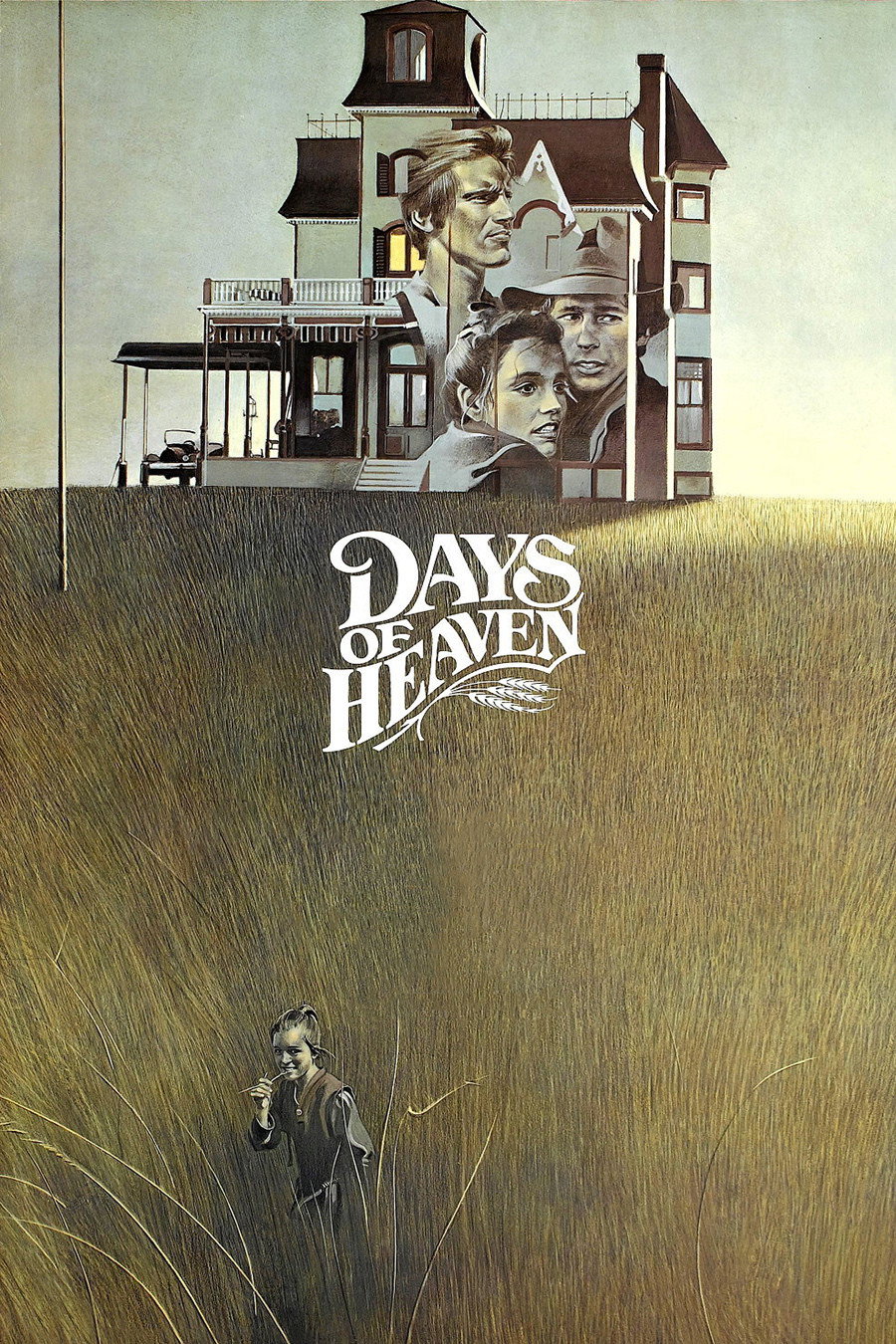
What the Film Is About
The first time I experienced Days of Heaven, it struck me less as a story and more as a sensation—an emotional current that carried images, sounds, and unspoken longing. From the opening frames, bathed in that late-afternoon magic, the film washed over me like a memory just out of reach. As I immersed myself in Terrence Malick’s vision, I realized the film wasn’t about what happened so much as about how it felt to live at the edge of hope and ruin, suspended between aching beauty and quiet tragedy. There is a story here, yes, involving restless lovers, desperate for a better life, pretending for survival and caught in a web of deception and fate. Yet what lingers most is not the plot but the haunted feeling of belonging nowhere, always looking towards horizons gilded by both promise and dread.
Instead of tracking character arcs point by point, I found myself reflecting on what the land, the light, and the smallest gestures communicated. The Texas Panhandle, in the era before World War I, becomes a canvas for all things lost and fleeting. The film follows Bill, Abby, and Linda—a makeshift family taking up transient work on a wheat farm owned by a young, ailing farmer. Their identities and relationships blur in the summer light, their love overshadowed by secrets. Yet nothing stays clear-cut; every image is smudged by uncertainty, just as every field is rimmed by dust and gold.
Core Themes
What kept drawing me back to Days of Heaven was the overwhelming sense of impermanence, as if every element in the film—people, wheat, sky—were on the edge of vanishing. The film’s heart beats with the theme of transience. As I watched fields bend under the wind, I felt the passage of time not as something linear but as a tide that erases and reveals. There’s an intense nostalgia for things that never fully belonged to the main characters, or to us, and a pervasive hunger for grace that always hovers just out of reach.
At its core, the film questions the human pursuit of happiness and stability in a world ruled by unpredictability. The characters’ actions are shaped as much by yearning as by survival instincts. Disguises—pretending to be siblings, feigning love or health—stand as a testament to how life often requires masks, both to fool the world and ourselves. Malick, I think, suggests that no matter how elaborate our schemes or wishes, we remain at the mercy of larger, indifferent forces—nature, society, fate. This fundamental sense of our smallness gives the film its melancholic beauty and existential weight.
There is also an undercurrent of the American dream, or perhaps the disintegration of it. Bill and Abby move through the world as workers and wanderers, drawn towards the hope of ownership and belonging. The wheat fields—shimmering with promise, yet always threatened by fire or harvest’s end—seem to embody the moment just before fulfillment turns to loss. I myself felt, in these images, the bittersweet reality that what is most beautiful is also the most fleeting. The search for home, for abundance, for love without complication, is always shadowed by the knowledge that it can’t last.
Loneliness and isolation thread through every scene. Despite moments of kinship and affection, the main characters are forever outsiders, never truly settling. I was moved by how Malick uses silence and landscape to reflect inner states—vast, empty skies mirroring private longings, endless fields echoing the loneliness that persists even in the midst of brief happiness. It is a film that asks whether happiness is ever more than a pause in an otherwise relentless tide of change and uncertainty.
Symbolism & Motifs
What continues to fascinate me about Days of Heaven is its almost mythic use of visual and sonic motifs. Every frame teems with meaning that goes beyond the immediate. The wheat fields themselves are both setting and symbol. To me, they represent not just wealth or labor but the fragile abundance of life—always threatened by human carelessness, fate, nature’s power. I recall how the camera lingers on stalks rippling in the wind, or how swarms of locusts and the outbreak of fire act as biblical portents, reminders of nature’s ultimate supremacy over human ambition.
The recurring imagery of harvest time sharpened the sense of finality: everything growing must be cut down. This rhythm of growth and destruction is mirrored in the characters’ own brief season of happiness, destined to be swallowed by consequences both natural and human-made. Even the farmhouse, set against the endless plains, becomes a symbol of precarious refuge—just as the characters can never hold onto it, so, too, can we never hold onto security or peace for long.
Malick’s use of light—especially the so-called “magic hour”—works as a visual language of transition. Watching those dusky golds and purples, I felt as if the characters moved in a perpetual state of longing, their present suffused with nostalgia for whatever has just passed or is about to be lost. Light becomes memory; darkness, oblivion. The relentless movement of clouds and the constant wind remind us that nothing in this world stands still.
Animal imagery is used with equal potency. The buffalo, birds, and insects that fill the fields are not mere background; they form a silent chorus to the human drama, sometimes echoing, sometimes mocking the characters’ striving. When I saw Linda—often silent, always observing—cradling a small animal or standing amid a flock, I sensed that Malick wanted us to remember that human lives are just part of a much wider, older pattern, one that will continue with or without our stories.
Finally, the voiceover by Linda (Linda Manz) haunts the film like a half-remembered dream. Her naïve, matter-of-fact commentary gives the story a distance, as if we are recalling something that might not have happened—or that exists now only in the retelling. This device, for me, reinforced the sense of myth and legend, lifting the film from the realm of realism into poetry.
Key Scenes
Key Scene 1
The first scene that imprinted itself on me was the harvesting sequence. As dozens of workers move through the fields, the machinery churning behind them, I was mesmerized by the hypnotic rhythm and the sense of community-in-isolation. Here, labor is as much ceremony as necessity. I found myself thinking about the fleetingness of abundance: those fields, so full, already preparing to be emptied. The wheat’s golden hue, the dust hanging in the air, and the distant sound of machines seemed to encapsulate both the promise and precarity of the American dream. In a way, I saw this scene as the calm before disaster; each cut stalk another step towards the inevitable reckoning.
Key Scene 2
The fire in the wheat fields—one of the most iconic moments in the film—was for me a turning point, both visually and emotionally. Watching flames rapidly consume acres of carefully tended wheat, I felt the raw, uncontrollable violence of nature and fate. There’s a grandeur to the destruction, a visual spectacle that both seduces and warns. The characters, silhouetted against the inferno, become tiny, almost helpless. What struck me most was not merely the loss of livelihood, but the loss of hope that comes with it—a visceral reminder that no matter how hard we try to control our destinies, we are ultimately at the mercy of forces greater than ourselves. The sense of inevitability here is crushing, and it reverberates through the film’s final act.
Key Scene 3
The quiet, ambiguous ending—where Linda narrates her reflections and the landscape stretches endlessly—remains the scene I return to most in my mind. There’s a serenity mingled with heartbreak. After all the turmoil, the survivors move on, just as the seasons do. The world does not end because a single life is overturned. I was struck by the way Malick offers no closure, no neat summing-up. Linda’s voice, part child, part oracle, hovers between past and future. Her closing words seem both random and profound, as if the meaning of everything that’s come before can only be glimpsed sideways, through recollection or rumor. For me, this scene crystallizes the film’s themes: time erases hurt and happiness alike, but somewhere, stories linger in the wind.
Common Interpretations
For years, viewers and critics have debated what Days of Heaven ultimately means. Some see it as an exploration of the American experience—of migration, resource extraction, and unattainable dreams—in the early twentieth century. Others focus more on Malick’s philosophical sensibilities: the interplay of innocence and corruption, the impossibility of escaping moral consequences, or the indifferent beauty of the natural world.
Personally, I find that the film channels a deep sense of original sin, not in a religious sense but as an existential condition. Characters are punished not simply for wrongdoing but for reaching too far, for misreading their place in the world’s order. This feels especially resonant when I consider how the land itself acts as both a stage and a silent judge, offering bounty but also exacting a price for hubris or short-term thinking. There are echoes here of classic American literature—John Steinbeck and Willa Cather—and their skepticism about the dream of endless prosperity.
Another thread of interpretation, which I share, emphasizes the poetic narration. Linda’s perspective is not omniscient; she is a child trying to make sense of adult decisions and the mysteries of loss and love. This choice makes the story elliptical and fragmentary, more about emotional truth than empirical fact. I have always found that this destabilizes the viewer, pulling us away from judgment and towards empathy.
Some critics interpret the film as a meditation on the fragility of happiness and the inevitability of loss. The love triangle at the center is less about passion or betrayal and more about the impossible search for safety in an unsafe world. I find myself returning often to Malick’s subtle skepticism—not about love per se, but about permanence itself. Love here is always threatened, beauty is always dissolving, peace is always temporary. To me, that is both devastating and oddly comforting, a recognition that nothing lasts and that memory is both the thing we cling to and the thing that betrays us.
Films with Similar Themes
After being so profoundly moved by Days of Heaven, I naturally sought out films that conveyed similar textures of longing, nature’s indifference, and the search for meaning in the American landscape. Among the most immediate kin is Malick’s own Badlands (1973), which uses a similarly poetic approach to tell a story of outlaws and innocent eyes, with landscape nearly as central as the plot itself.
I also found much resonance in John Ford’s The Grapes of Wrath (1940). Both films engage with themes of migration, work, and the tenacity of hope amid hardship, using the land not just as backdrop but as an active force in the characters’ fates. The lyricism and sense of place are not quite the same—Ford’s world is harsher, less elliptical—but both films meditate on outsiders searching for their piece of earth.
Visually and thematically, Andrei Tarkovsky’s Mirror (1975) comes to mind. The use of nature, memory, and time as both structure and content creates a similar feeling of drifting reverie, of characters shaped by forces they never fully understand. What draws me most to these films is their resistance to simple answers or didactic narratives. They evoke emotional realities in ways that linger long after the credits roll.
More recently, P.T. Anderson’s There Will Be Blood (2007) and Kelly Reichardt’s Meek’s Cutoff (2010) echo Malick’s fascination with landscape as destiny, with the tension between ambition and ruin, and with the stark, sometimes brutal truths beneath surface beauty. Each in their way, these films ask whether happiness—like the harvest, like the magic hour’s light—can ever truly be possessed.
If you’re deciding what to watch next, you might also want to see how this film holds up today or how it was originally received.
🎬 Check out today's best-selling movies on Amazon!
View Deals on Amazon