
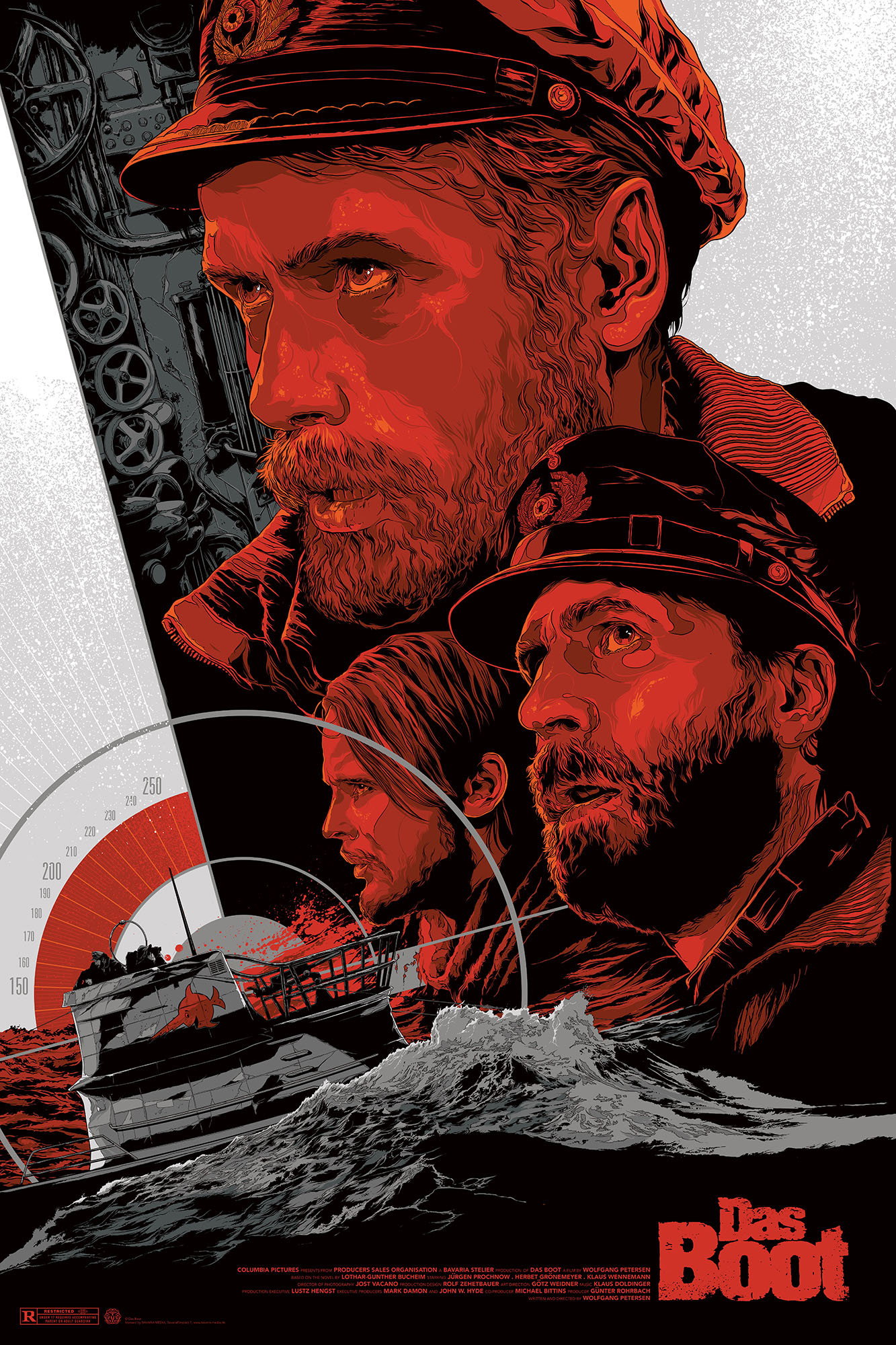
What the Film Is About
The first time I watched “Das Boot,” I was gripped not only by its technical prowess but also by the oppressive, suffocating feeling that seemed almost to seep from the screen. I could feel the dank air of the submarine, the claustrophobia, the paranoia, the mounting sense of futility. More than a mere war film, “Das Boot” envelops viewers in a mental space alongside its crew, making the story about far more than military maneuvers or the mechanics of naval combat. There’s an intensity to the experience, as if the submarine becomes less a machine and more a crucible testing the limits of human endurance, trust, and morality in wartime.
Set aboard a German U-boat during World War II, the narrative eschews epic battlefields for a tunnel-like intimacy. What stuck with me was how the film roots itself in the day-to-day lives of sailors—how they eat, laugh, bicker, stare at nothing, or struggle to sleep amid persistent danger. The great drama is not in the fate of nations, but in the fate of individuals trapped together, confined and inexorably changed by the endless churn of water and the relentless ticking of the clock.
Core Themes
One overriding theme that emerges for me is the dehumanizing power of war. Throughout “Das Boot,” the enemy is almost invisible—ships glimpsed through periscopes, distant sonar pings. I found that this anonymity strips war of easy heroics, underscoring the existential plight of the crew. Their enemy is sometimes the ocean itself, other times the machinery, boredom, or even the creeping despair of knowing they fight for a cause that grows ever less certain. As I watched, I couldn’t help but reflect on the notion of powerlessness—how the characters come to realize that their fate is sealed not by what they do, but by forces vast and indifferent to their suffering.
Another theme that resonated deeply with me is camaraderie within confinement. The members of the U-boat crew aren’t cast as fanatic warriors. They are young men, some jaded, some naïve, all clinging to their small rituals to maintain a sense of identity amidst the war’s machinery. These rituals—a birthday, a joke, a song—become acts of resistance, reminders of life before the war and perhaps life after. Their only shield against the psychological assault of monotony and fear is one another. Watching this, I was reminded of how, in extreme conditions, the ordinary moments between people often become the most meaningful.
I also found myself wrestling with the theme of obedience to authority. The Captain, emblem of discipline and tradition, toes the line between protecting his men and carrying out orders motivated more by political ambitions than survival. Here, the film seems to urge me to consider the moral cost of obeying orders, especially when personal conviction wavers in the presence of larger, abstract causes. The through line is clear: pressed into obedience, individuals face devastating inner conflict between duty and conscience.
Finally, there’s the question of hope and futility—of whether survival has meaning when stripped of context and dignity. As the voyage drags on, hope for home or victory is continually deferred, and the only thing left is the struggle to see another day. The circularity of suffering is mirrored in the submarine’s endless patrols, its neverending cycles of dive and surface, tension and brief relief. For me, the film insists that sometimes survival is not heroism, but merely endurance in the face of meaninglessness.
Symbolism & Motifs
From my perspective, “Das Boot” is layered with motifs that distill the film’s psychological landscape. The submarine itself is among the most potent: an iron coffin, at once a shield from the outside world and a prison without escape. The vessel accentuates the fragility of its contents—every leak, groan, or failed system symbolizing not just mechanical malfunction but the precariousness of human life under pressure, both literally and figuratively. The U-boat is also a microcosm: the wider world condensed into a single corridor, with all the hierarchies, fears, and politics that entails.
I also found the recurring motif of water deeply resonant. It is both omnipresent and indifferent—a barrier, a grave, a threat, and sometimes, in fleeting moments, an object of beauty glimpsed through a porthole. Water is as much an antagonist as any enemy ship, representing fate or nature’s indifferent power over the lives of men. Scenes where water seeps or floods into the submarine evoke dread, a visceral reminder of mortality—a pitiless force, answering no prayers.
Silence and noise, too, play critical symbolic roles. Moments when the crew must remain perfectly still, barely breathing, contrast with the deafening roar of depth charges or alarms. This auditory tension echoes the crew’s psychic strain, the oscillation between anticipation and terror. In my viewing, even ambient sounds become psychologically loaded—each clang or creak signaling the fine edge between safety and catastrophe.
Ideological symbols—portraits of Adolf Hitler or patriotic music—appear with bitter irony. The crew’s indifference to these icons, or their mocking subversion, further underlines the disconnect between individual experience and official propaganda. The slow crumbling of ideological certainty is marked in small gestures: torn posters, muttered jokes, eyes rolling at speeches. These fragments of resistance pointed me to the core existential crisis in the story—the search for meaning amid the vacuity of slogans and orders.
Key Scenes
Key Scene 1
What continues to haunt me is the scene of the first torpedo attack. The U-boat, camouflaged beneath the waves, becomes a silent predator. The preparations, executed with mechanical efficiency, are juxtaposed with the anxious faces of the young crew. Torpedoes fire; soon, explosions echo, and through the periscope, carnage unfurls in slow motion. Ships burn, men jump into the sea. In this moment, the thrill of technical success is instantly undercut by horror—a momentary, sickening epiphany. The war, far from being glorious, reveals itself as a mechanical process of destruction. I recall the Captain’s silent remorse, how the camera lingers not on celebration, but on the devastation. Here, the ethics of proximity are laid bare: once faceless enemies become painfully real, washing away any certainty about the righteousness of action.
Key Scene 2
The prolonged depth-charge sequence is another point of almost unbearable tension. As the U-boat is hunted by enemy destroyers, the crew sits immobilized, every muscle cramped, each breath calculated. For me, the immersion in this tension was claustrophobic—each metallic groan of the hull, each distant detonation a reminder that death might come not in battle, but in slow, suffocating isolation. I observed how fear strips away social conventions, exposing core human responses: panic, prayer, resignation, or a desperate joke. The sensory deprivation—darkness, sweat, recycled air—heightens the psychological toll. I felt as if I were part of the crew, disciplined by necessity, united by the sheer need to survive. When the attack finally ends, there’s no heroic cheer; just exhausted silence. In these moments, I recognized the enduring human need to find meaning in adversity, even when official narratives and ideals fail.
Key Scene 3
Equally affecting is the homecoming sequence. Against all odds, battered but alive, the submarine limps back to port. The emotional high is palpable—then instantly undercut as an air raid devastates the harbor. Any hope of respite is obliterated in seconds. The Captain collapses, fatally wounded; the crew’s sacrifices and endurance are made hollow by arbitrary violence. I remember feeling the sheer brutality of war’s pointlessness—how survival offers no reward, only further loss. The cyclical nature of violence is completed: whatever meaning was constructed during their ordeal is snatched away, leaving only the echo of their struggle. In my view, this ending is a definitive statement about the absurdity and tragedy of conflict, about how war devours not only its enemies, but even those who endure it.
Common Interpretations
Reactions to “Das Boot” have always been complex. Some see it as an unflinching anti-war statement, one that deliberately avoids glorifying combat in favor of realism. For me, the film’s genius lies in its refusal to place blame or offer easy catharsis. The choice to focus on German sailors, often stereotyped as villains, provokes challenging questions about complicity, humanity, and historical narrative. Watching these men suffer does not excuse the regime for which they fight—but it compels empathy for individual suffering within systems beyond individual power. This ambiguity unsettled me at first, but ultimately forced me to reconsider simplistic divisions between enemy and ally, good and evil.
Others interpret the film through a psychological lens, emphasizing the impact of prolonged stress and threat on the human mind. The submarine, in this view, is a setting for existential confrontation: stripped of distractions, forced to confront mortality, the crew is a study in the persistence of life’s absurdities under duress. For me, this reading resonates most powerfully: the U-boat patrol as a metaphor for human existence, pressured from without, bound by arbitrary rules, and driven by an irrational faith in survival.
There’s also a powerful indictment of obedience. The Captain, a weary professional, must balance his own skepticism with his duty to carry out orders from the Nazi command. His struggles with authority figures—contrasted with the youthful idealism or cynicism of his crew—highlight the costs of unquestioned obedience, especially when the underlying cause becomes suspect. I saw in this a reflection not only of the war, but of any system in which obedience is prized above conscience.
Lastly, many pick up on the motif of technology as both savior and executioner. The submarine is a product of industrial modernity—it is what keeps the crew alive and what constantly threatens to kill them. The film’s relentless attention to mechanical detail often left me feeling a cold admiration for human ingenuity mixed with a sense of dread at how easily that ingenuity turns lethal. In this sense, “Das Boot” is haunted by the paradox of progress: the same skills that extend life are also those that refine destruction.
Films with Similar Themes
Inevitably, watching “Das Boot” led me to consider other films that tackle the existential predicament of wartime survival and the ambiguity of obedience. “Paths of Glory” (1957), directed by Stanley Kubrick, similarly dwells on the arbitrary nature of military orders, the cruelty of hierarchy, and the emotional toll exacted upon individuals. Both films resist the allure of conventional heroics, insisting on the ordinary, vulnerable humanity of their protagonists.
Another touchstone is “The Thin Red Line” (1998) by Terrence Malick, which interrogates the spiritual and existential impact of war through intimate character studies. The sense of alienation, the moments of unexpected beauty amid carnage, and the theme of nature as both destroyer and indifferent bystander form strong thematic echoes. Like “Das Boot,” Malick’s film cultivates a powerful sense of interiority, of men thrown together by chance, all longing for meaning and solace in a landscape of chaos.
“Come and See” (1985), a harrowing Soviet war film, also insists on the physical and psychological realities of war without the filter of sentimentality. Its focus on the trauma suffered by civilians and soldiers, its refusal to offer simple catharsis, and its close, almost suffocating camerawork all recognize the universality of suffering and the hollowness of ideology in the face of death and devastation. The impact on me was similar: a sense that every war film, to be honest, must ultimately admit the futility and sorrow at its heart.
Contemporary submarine films such as “The Hunt for Red October” (1990) or “Crimson Tide” (1995) riff on some of the same themes: the pressure of command, the terror of possible annihilation, and the fraught ethics of military duty. However, for me, these later films rarely match the relentless focus and harrowing realism of “Das Boot,” which remains singular in its immersive identification with the ordinary sailor rather than the fate of nations or the calculus of strategy.
If you’re deciding what to watch next, you might also want to see how this film holds up today or how it was originally received.
🎬 Check out today's best-selling movies on Amazon!
View Deals on Amazon