
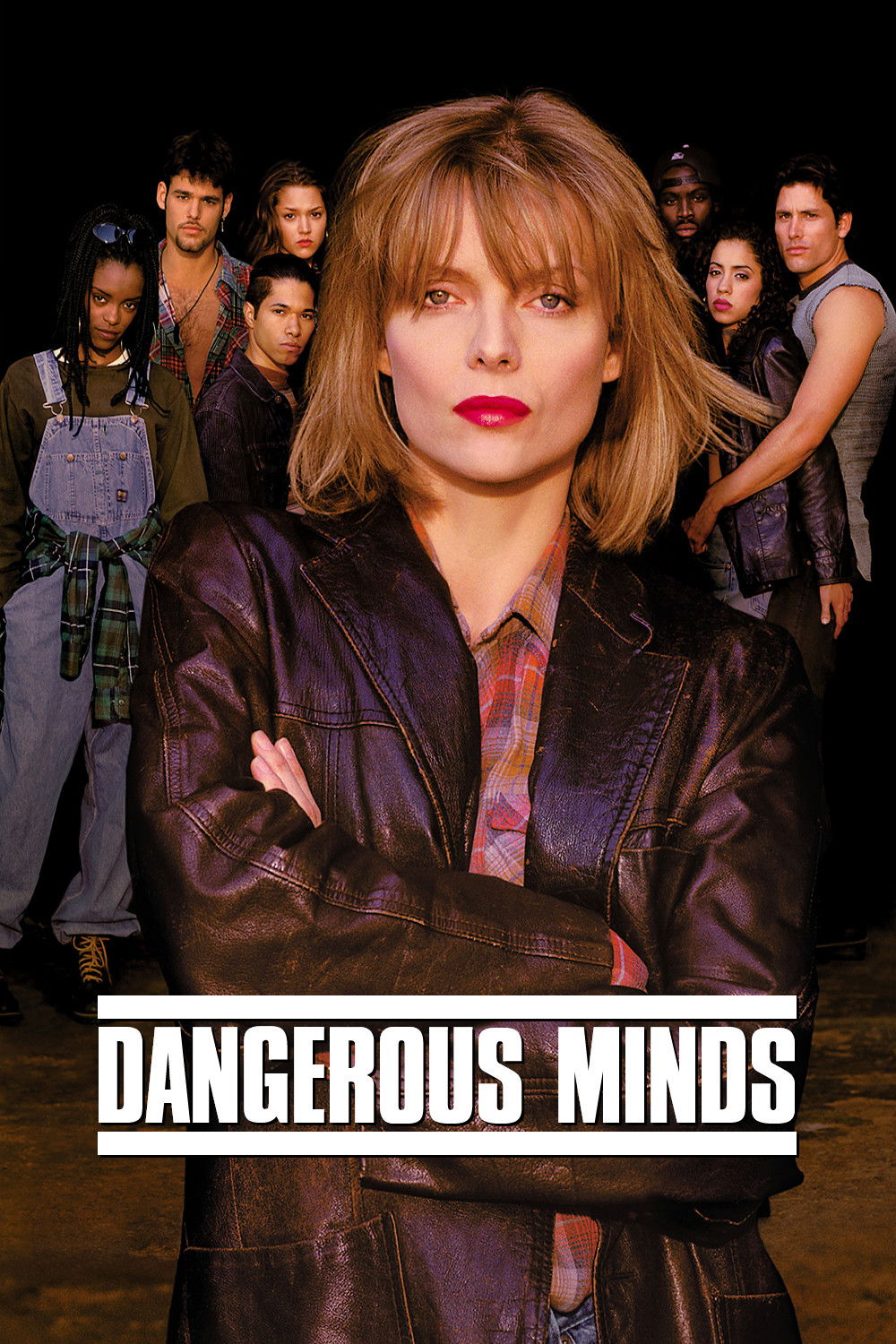
What the Film Is About
Even now, looking back on the first time I experienced “Dangerous Minds,” I recall an intense mix of skepticism and curiosity. Here was a film that threw me, almost bodily, into the chaos and beauty of a worn-out classroom in an underfunded school in California. As someone inherently drawn to stories of struggle and transformation, I wasn’t looking for a conventional teacher-saves-the-day narrative. What struck me, and continues to arrest my attention all these years later, is how “Dangerous Minds” asks us to sit with discomfort: both the discomfort of confronting systemic failures and the discomfort of finding hope where it should be suffocated.
Loosely based on the real-life memoir of LouAnne Johnson, a white ex-Marine who took a job teaching English to mostly Black and Latino students, the film is not really about knowledge in the conventional sense. For me, it is about connection and the possibility of mutual human recognition in a landscape laced with misunderstanding, poverty, and pragmatic violence. “Dangerous Minds” did not reinvent cinematic storytelling or teaching narratives, but it did force me to reckon with my own assumptions. Where I anticipated clichés, I found surprisingly raw moments of vulnerability—on all sides of the classroom.
Core Themes
Peeling away the glossy surfaces, I see “Dangerous Minds” as a film preoccupied with the possibilities and limitations of transformation. Its most resonant themes revolve around the institutional alienation experienced by marginalized youth and the personal compulsion to intervene, often awkwardly or insufficiently, in that alienation. For me, the classroom is never just a site of learning—it’s a battleground. The students’ world is shaped less by the curriculum than by their daily negotiations with violence, poverty, racism, and a society that deems them expendable.
Foregrounded, of course, is the uneasy dynamic of an outsider seeking to “save” students. Yet, what hit me on a deeper level is the reciprocal journey: While LouAnne Johnson tries to rescue her students, it’s her own world—her sense of efficacy, her understanding of humanity—that is cracked open. The film grapples with the ethics of empathy: When LouAnne reaches out, is she imposing her values, or is she genuinely attempting to meet her students where they are? Each viewing prods me to examine the power differentials inherent in education and the burden of representation. The very act of trying to help can teeter on the edge of condescension unless it is reflexive and humble.
But the film’s most enduring theme for me is survival—intellectual, emotional, and physical. The students’ resistance to authority is both a refusal to be patronized and a survival strategy honed over years of institutional betrayal. I am reminded of conversations about structural inequality in America, of how schools can both mirror and exacerbate the wounds of social systems. Hope, in this context, is radical: It’s not wishful thinking but a form of resistance.
Symbolism & Motifs
Films like “Dangerous Minds” bank heavily on symbolic gestures, and this one is especially rich in visual and thematic motifs. What stands out to me most are the objects and rituals of the classroom, which mutate from symbols of oppression to vehicles of agency. The literature LouAnne introduces—Dylan Thomas’ “Do Not Go Gentle into That Good Night”—becomes more than just a poem. For her and the students alike, it is a rallying cry, an invocation to persist against the suffocating force of circumstance.
The motif of the chalkboard—wiped clean and covered again, erased and rewritten—haunts me even now. It suggests, however sentimentally, that every day brings the possibility of a new narrative, even as yesterday’s failures ghost the present. The candy bars LouAnne uses as rewards are at once a sincere gesture of connection and a jarring reminder of the gap between her world and her students’ realities. I often find myself uncomfortably aware of how something so trivial in one life can mean so much in another, especially to kids for whom small comforts are rare.
I am also struck by the motif of invitation and exclusion: the ritual of stepping into the classroom, the challenge to take part in learning, and the ever-present threat of being pushed out—by pregnancy, by violence, by bureaucracy. Each motif accumulates through repetition, giving the film a texture that, while sometimes heavy-handed, resonates in its honesty about how fragile belonging and achievement can be.
Key Scenes
Key Scene 1
The first classroom encounter sets the film’s tone. I remember my unease as LouAnne Johnson arrived, her military bearing incongruously at odds with the wary, armored students facing her. The mutual suspicion in this scene is palpable. The students are uncooperative—no, they are hostile. With every gesture and dismissive glance, I felt the weight of a long history of adults parachuting in to “fix” them. In that moment, I understood the classroom not as a place of open possibility, but as a site of defensive resilience. LouAnne’s desperate pivot—turning to bribery, using candy bars to bridge the chasm—evoked in me both uneasiness and reluctant admiration. What do we owe those we wish to help? Is genuine connection ever possible under such loaded circumstances?
Key Scene 2
The “Poetry Contest” scene lingers in my memory as a subtle but profound turning point. LouAnne uses the rhythm and fury of Dylan Thomas to crack her students’ stony exteriors. What this scene impresses upon me is not just the power of poetry but the power of acknowledgment, of having someone insist that your thoughts, your anger, your hope, are worthy of expression. Watching the students gradually participate, I experienced a catch in my own throat: I, too, have yearned for affirmation that my voice matters. Yet the poetry does not perform miracles. The students’ engagement is tentative, their pride tempered by suspicion. The scene resists easy triumph, and that’s precisely what gives it gravity. It reminded me of how real transformation is neither swift nor riskless; it is negotiated, hard-won, and always incomplete.
Key Scene 3
The aftermath of Emilio’s death devastates both LouAnne and the viewer. When LouAnne learns that Emilio, who had once begun to trust her, has been killed, the camera lingers on her devastation and the students’ quiet rage and grief. This moment seared itself into me, not as a narrative device, but as a grim reminder that “success” in education—or in any fraught human relationship—cannot always shield people from the systems stacked against them. The scene obliterates illusions: No matter how much LouAnne gives, the forces outside the classroom—gang violence, institutional apathy—may outpace her every effort. Unlike Hollywood endings, this loss is not redemptive. Instead, it’s a demand that we face the consequences of our collective neglect.
Common Interpretations
Over time, I have encountered numerous responses to “Dangerous Minds,” ranging from admiration to sharp critique. Many viewers interpret the film as a straightforward paean to individual willpower and gritty determination. On first viewing, I, too, was tempted to read it as a testimony to the difference a single teacher can make. However, as I returned to the film, I realized that this reading is not just limited but potentially hazardous; it risks placing the entire burden of change on individuals—on heroic teachers—while letting the system off the hook.
Others have criticized “Dangerous Minds” for perpetuating the tired trope of the “white savior,” a reading that resonates with me, particularly in moments where the film foregrounds LouAnne’s perspective while sidelining the inner lives of her students. I have wrestled with this tension, recognizing how, despite moments of genuine connection, the narrative still privileges the outsider’s journey over the community’s lived reality. Still, I find it too dismissive to reduce the film to its most problematic elements alone. There are eruptions of authenticity within the clichés, exposing genuine moments of reciprocal change and mutual vulnerability.
Some viewers focus instead on the film’s attempt to render visible the educational and social barriers faced by students of color in urban schools. I have come to appreciate “Dangerous Minds” for at least raising the uncomfortable questions that so many would prefer to leave unspoken. The film traffics in sentimentality at times, yes—but beneath the surface, it acknowledges the impossibility of easy answers.
Films with Similar Themes
My journey with “Dangerous Minds” has inevitably led me to seek out other films that reckon, in honest and uncomfortable ways, with education, race, class, and transformation. When I watch “Stand and Deliver,” I encounter another mythologized but stirring story—this time with Edward James Olmos’s real-life portrayal of Jaime Escalante, a Bolivian-born math teacher in East Los Angeles. The parallels are obvious: underdog educators, neglected classrooms, the relentless push against the undertow of institutional racism. Yet each story offers something unique in tone and implication.
Another film, “Freedom Writers,” brings its own emotional register, centering on a young teacher’s attempts to reach her students through journal writing. I notice how this film, like “Dangerous Minds,” grapples with the blurred boundaries between empathy, agency, and saviorism. Though sometimes polemical, “Freedom Writers” reminds me that the classroom can be both a refuge and a crucible.
Even films outside the classroom, such as “The Class” (Entre les murs), a French drama, echo these themes for me. In “The Class,” the power dynamics between teachers and students feel more diffuse but perhaps more truthful. Each of these films, in their own way, insists on what “Dangerous Minds” proposes: the transformative—but never complete—potential of authentic engagement across lines of difference.
What ultimately binds these films together in my mind is their insistence that hope must be both fierce and humble. They force me to remember that reaching past the chalkboard, past the movie screen, is always a risk—one never entirely under any one person’s control. The lessons echo: connection is possible, but always contingent; change is necessary, but always unfinished.
For more context before choosing your next film, these perspectives may help.
🎬 Check out today's best-selling movies on Amazon!
View Deals on Amazon