
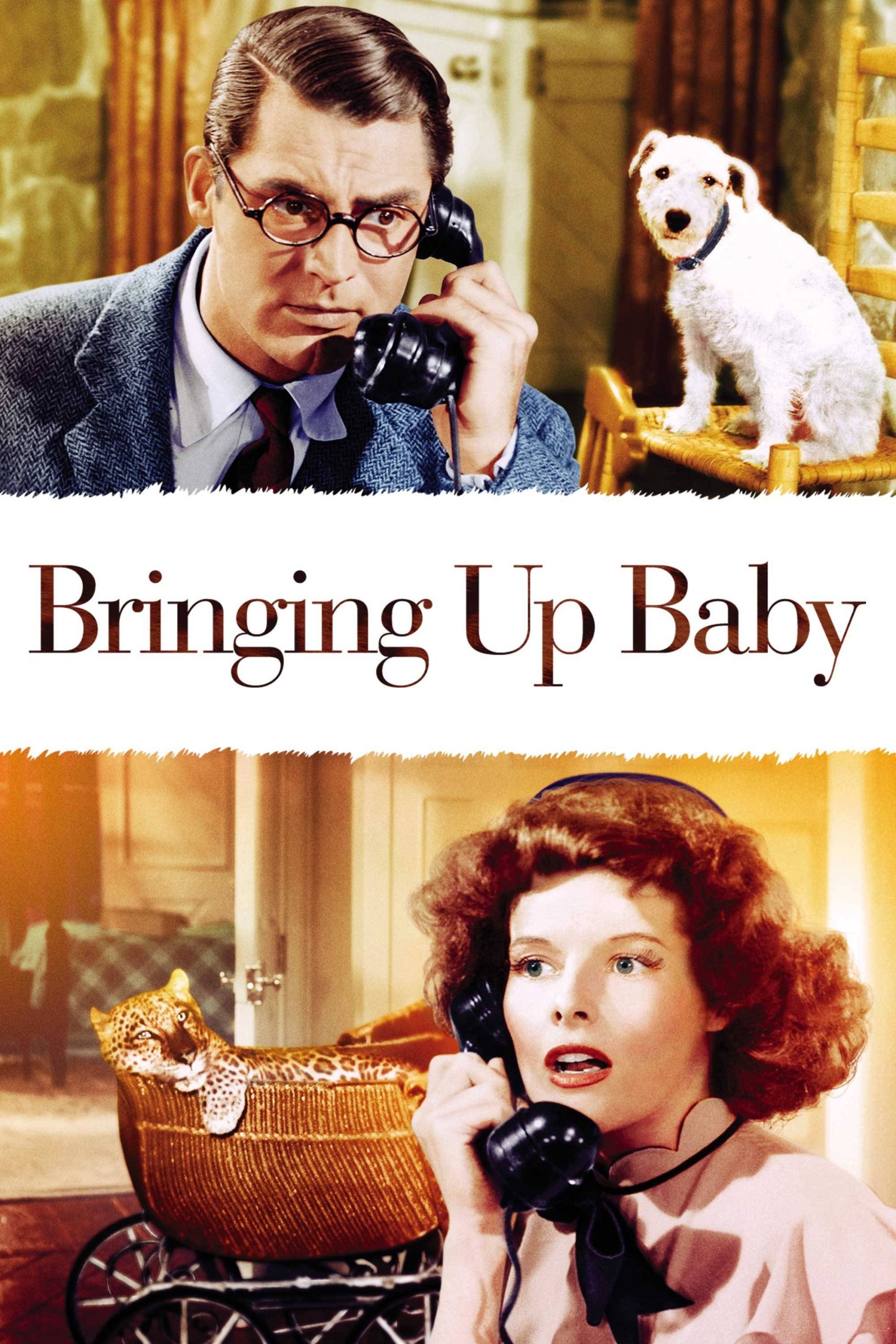
What the Film Is About
Whenever I recall my first experience watching “Bringing Up Baby,” I’m struck by how off-kilter the world briefly felt. Here was a film that upended the tidy orderliness I expected from romantic comedies. Rather than transporting me to some gentle, predictable courtship, it spun me into a spiral of chaos and unpredictability, led by two dazzling performers, Katharine Hepburn and Cary Grant, whose willingness to throw convention out the window felt both frightening and liberating. On its surface, this 1938 screwball comedy could be dismissed as simple madcap mayhem—a fast-talking woman, an awkward paleontologist, and a leopard named Baby, crashing through misunderstandings and physical gags. But for me, its true gravity lies not only in its laughter but in the existential questions it raises about selfhood, freedom, and the disorderly nature of love. It is a masterful dance along the blurred boundaries of decorum, reason, and wildness, daring me to consider whether my ideas about purpose and control are more rigid cages than sources of comfort.
Core Themes
Reflecting on “Bringing Up Baby” through the lens of my own life, I am drawn to three interwoven themes: the destabilization of order, the malleability of identity, and the redemptive chaos of love. The film’s narrative chaos, for all its absurdities, serves as a potent metaphor for moments when I have felt unmoored, thrust into a world where rules no longer apply and only improvisation remains. For paleontologist David Huxley (Cary Grant), life is a delicate fossil he’s been assembling piece by piece—a project interrupted at every turn by Susan Vance (Katharine Hepburn), whose disregard for rules is less about malice than about pure, uninhibited living.
In the world outside the screen, I too have experienced the destabilization of carefully curated plans, and there is something relatable in David’s frazzled attempt to maintain control. His journey through the film mirrors my own struggles with letting go—of outcomes, of expectations, of the clean lines I draw to feel safe in a fluctuating reality. The film manages to gently prod me into considering that true self-discovery only occurs when we surrender, even momentarily, the illusion of mastery.
Another compelling thematic undercurrent is the film’s playfulness with identity. David, so defined by his scientific rigor and placid fiancée, finds those lines continually smudged by Susan’s presence. The process of unmaking and remaking David in Susan’s anarchic orbit requires not only a willingness to risk embarrassment but also the courage to face the unknown. Susan, for her part, is openly at war with the suffocating protocols of her class—a battle I recognize from my own bouts of discomfort with social scripts and the pressure to perform stability. Watching her chase liberation in the form of a leopard and a flustered scientist is more than farce; it is an expression of longing to be truly known and accepted in all one’s messiness.
And then there is love—messy, uncontrollable, and undeniably redemptive. If strict rationality could save David, “Bringing Up Baby” would be a cautionary tale. But the film gently persuades me that love thrives not in order, but in a shared willingness to embrace vulnerability and delirium together. The magic is not that chaos is conquered, but that it is reimagined as a space for intimacy and renewal. Whenever I feel the temptation to retreat into predictability, I remember how this film reorients love from structure to adventure, from certainty to risk.
Symbolism & Motifs
“Bringing Up Baby” is thick with symbolism and recurring motifs that continue to ripple through my thoughts long after the credits roll. The most obvious—yet most provocative—is the titular leopard, Baby. The leopard at once embodies the untamed potential within each of the main characters and serves as an almost mythical agent of disruption. To me, Baby is not just a literal animal, but the wildness that stalks beneath the civilized surface of life, waiting to be acknowledged.
There is also the persistent motif of lost and found: bones misplaced and found (and misplaced again), identities assumed and shed, and social roles disrupted with giddy regularity. These elements press me to question how much of what I consider essential in myself is simply the artifact of habit, susceptible to being lost and—if I am lucky—rediscovered in new forms. Every time a character loses something, it is an invitation to articulate who they are without it; every recovery is an opportunity to embrace change.
The dog George, who absconds with the priceless intercostal clavicle bone, is another critical symbol for me. George’s easy defiance of order—his joy in following nothing but his own doggy impulses—mirrors Susan’s approach to life. Both serve as reminders of what it looks like to live with abandon, indifferent to the logical constraints I so often impose on myself.
I also find resonance in the motif of mistaken identity, which recurs throughout the film—whether through costumes, false names, or farcical situations. This motif lays bare how fragile the boundaries of the self can be, and how much we rely on context and perception to anchor our identities. In my own moments of feeling unmoored, I have often clung to these boundaries for reassurance, but the film suggests there is a generative power in letting them blur, even if only for a little while.
Key Scenes
Key Scene 1
One scene that forever reoriented my understanding of cinematic comedy is the golf course encounter between Susan and David, just as their lives first begin to tangle. I have always been captivated by how swiftly order evaporates in a matter of seconds—David, earnest and composed, finds his golf ball missing and almost immediately plunges into Susan’s whirl of digression and mischief. What strikes me here is the sheer vulnerability of David; he stands as the proxy for all of us, uncertain how to respond to a force so immune to logic. In this scene, the golf course—a landscape of precise rules and etiquette—becomes a playground for unpredictability. It nudges me to consider the fragility of the structures I build to keep the world knowable and how someone else’s chaos can, paradoxically, set me free.
Key Scene 2
The leopard’s escape, and the ensuing chase through Susan’s aunt’s estate, is the film’s most overt embrace of chaos. I remember laughing at the mayhem but also feeling a deep pang of recognition—how many times in my own life have I found myself helplessly tracking after losses, missteps, or wild opportunities I never anticipated, all the while trying to maintain my composure? The hunt for Baby is a fever dream in which the characters are tested not only physically but existentially. As they stumble through shrubbery and darkness, costumes torn and facades slipping, I see a metaphor for the unplanned detours that reveal what I am truly made of. The frantic energy is less about resolution and more about transformation; in their shared disarray, Susan and David draw closer in ways that order would have never permitted.
Key Scene 3
The climactic collapse of the museum’s brontosaurus skeleton has always felt to me like a bravura gesture by director Howard Hawks—an act of gleeful destruction that strips away all artifice. In the literal and figurative rubble of David’s lifelong project, I see my own experiences of loss and reinvention. For David, as for so many of us, the dismantling of what was once precious makes room for unforeseen bonds and new versions of the self. The museum, meant to house control and mastery over history, is shaken to its foundations by the unpredictable forces of life—here embodied in both Susan and the runaway leopard. That moment’s humor is undercut by a quiet wisdom: sometimes, what I need most is for my structures to give way, making space for relationships that energize rather than ossify.
Common Interpretations
Over the years, I have encountered a broad range of perspectives on “Bringing Up Baby,” each reflecting the film’s layered possibilities. Some view it as pure comic escapism—a fantasy of disorder where consequences are always comic, never cruel. There are times when I have adopted this perspective, reveling in the safety of slapstick without thinking too deeply about its implications. But there is also a strong tradition of reading the film as a subversive critique of gender and class norms in late-1930s America, especially grounded in Katharine Hepburn’s bold performance.
From my point of view, the film’s most vital subversion lies in its treatment of control and chaos. Early interpretations treated David as the victim of Susan’s excesses, while more recent readings, including my own, see him as a necessary partner in mutual transformation. The comic violence inflicted on propriety and masculinity is not simply a joke but a process of recalibration—a way of asking what must be sacrificed for genuine connection. The fact that David ultimately embraces the very energy that first unnerved him resonates with my own journey toward appreciating unpredictability and even cultivating a bit of it in my own life.
Some critics treat the film as a prescient meditation on the limits of rationality, coming just before the outbreak of World War II, a moment when all manner of social, political, and scientific certainties were thrown into doubt. When I see the film against this historical backdrop, it deepens my appreciation for its capacity to mock the soothing yet brittle structures I cling to in troubled times.
Films with Similar Themes
Reflecting on what makes “Bringing Up Baby” so special for me, I find myself drawn to films that also interrogate the tension between order and chaos, often using romantic relationships as the crucible for transformation. Among the most significant is the 1940 classic “His Girl Friday,” directed by the same Howard Hawks and co-starring Cary Grant. In its rapid-fire dialogue and collision of professional ambition with personal vulnerability, I see another playful meditation on the risks that come with opening oneself to another person’s disruptive potential.
“Philadelphia Story” (1940), again starring Katharine Hepburn, similarly explores how love can overturn class-based snobbery and rigid identity. Here, as in “Bringing Up Baby,” chaos functions as a solvent, dissolving old personas and clearing the path for growth. I also think of “My Man Godfrey” (1936), which challenges social order through its depiction of Depression-era class dynamics, and “It Happened One Night” (1934), where two mismatched characters are forced into surrender by circumstances outside their control.
- “His Girl Friday” (1940) – Transformation through comedic chaos and gender role reversal
- “Philadelphia Story” (1940) – Class, identity, and the redemptive force of love
- “My Man Godfrey” (1936) – Crash of order, self-reinvention, and social commentary
- “It Happened One Night” (1934) – Surrender and the undulating power of unpredictability
Each film, in its way, echoes what I find so enduring in “Bringing Up Baby”: a courage to laugh at control, to embrace vulnerability, and to regard the unpredictable not as a threat, but as the birthplace of renewal.
For more context before choosing your next film, these perspectives may help.
🎬 Check out today's best-selling movies on Amazon!
View Deals on Amazon