
What the Film Is About
When I reflect on my first experience with “Come and See,” the visceral memory is almost physical—a weight in my chest, a splintering behind my eyes. Watching Elem Klimov’s masterpiece wasn’t something I did out of casual curiosity; rather, it became a kind of confrontation, an ordeal that demanded my full attention, my compassion, and a loss of innocence—both for the film’s protagonist and, in a sense, for myself as a viewer. “Come and See” isn’t a traditional war film; it offers nearly nothing of the valor, strategy, or glory usually associated with depictions of conflict. Instead, I felt thrust onto the ravaged fields of Belarus in 1943, forced to bear witness to the unspeakable cruelty inflicted on civilians during Nazi Germany’s occupation of the Soviet Union. The story is, on the surface, a journey through the eyes of Florya, a peasant boy who believes joining the partisans will offer purpose and adventure. By the end, it’s difficult to distinguish the ghosts haunting him from the civilian trauma I’ve absorbed as his witness. The film’s about war, yes—but more deeply, it’s about the annihilation of hope, the shattering of humanity, and the transformation of a boy into a silent vessel of horror.
Core Themes
What unsettles me most each time I return to “Come and See” is how it blurs the lines between horror and realism. Rarely do films force me to confront, so relentlessly and intimately, the true nature of evil and the fragility of human identity. Amidst the madness and decay, what emerges most forcefully is a meditation on the loss of innocence. Florya isn’t simply a witness; he is a living palimpsest, his youthful face erasing and overwriting itself with every fresh atrocity. I find myself reflecting not only on what he sees, but on what he can never unsee—an internal massacre that feels both universal and deeply personal to anyone who has brushed against the darkness of history.
Another inexorable theme is the erasure of individual dignity. The peasants and partisans become indistinguishable from the land itself—muddy, wounded, scorched. Klimov doesn’t allow me to look away from the way war erodes every social fabric: the casual brutality, the shattering terror, the stripping away of language and name. The film makes it clear that war’s greatest atrocity is not merely physical destruction, but the psychic mutilation that dehumanizes both victim and perpetrator. As I watch, I’m forced to reckon with the terrifying ease with which moral compasses are obliterated.
By refusing to imbue suffering with any sense of catharsis or redemption, “Come and See” uniquely meditates on the cyclical nature of violence. The film’s final, wordless coda—reversing history as Florya fires into the image of Adolf Hitler—embodies a hopeless longing to undo the bloodshed, to reclaim something irretrievably lost. Watching, it’s as if I’m trapped in that same loop, desperate for release but unable to untangle reality from nightmare. The core of the film’s meaning, for me, is its insistence that there is no separation between past and present when trauma remains unacknowledged or unhealed.
Symbolism & Motifs
I’m especially drawn to the hypnotic, dreamlike logic that Klimov weaves through the use of recurring symbols. The ever-present mud is more than just a setting; for me, it’s a suffocating metaphor for the moral quicksand of wartime complicity. The earth, repeatedly churned by violence, clings to every character—no one leaves untainted, each step deeper into the mire an abandonment of innocence.
The constant, intrusive sound—a distant roar, the buzzing of flies, the shelling—serves as a relentless reminder that peace is always provisional. The sound design is not merely atmospheric, but invasive: it transforms the act of watching into a bodily experience. I find myself flinching, my own nerves frayed in tandem with the on-screen devastation. That sonic assault comes to symbolize the inescapability of trauma, the psychological wounds that echo long after the guns fall silent.
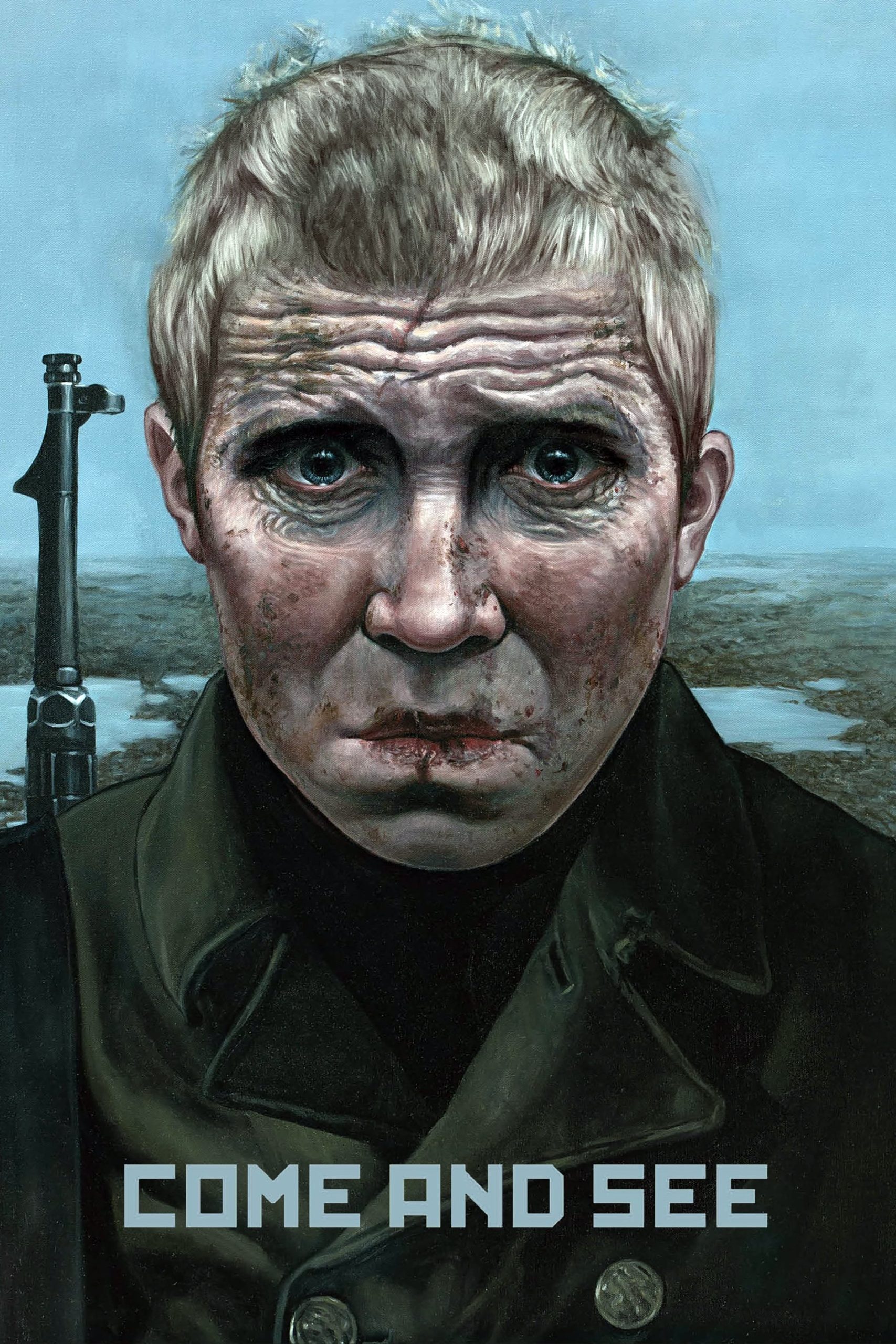
Perhaps the film’s most enduring image, for me, is Florya’s face. Klimov’s camera fixes on his gaze, as if to force the audience to bear a fraction of what he endures. His transformation from bright-eyed adolescent to hollowed-out survivor is the film’s most unsparing motif. The final shot of his face, ravaged beyond its years, haunts me long after the credits fade—it’s an emblem not only of personal suffering, but of the mass trauma inflicted on generations by war.
Another element I find deeply symbolic is the motif of eyes and seeing. The act of looking—at death, at atrocity, at the ruins of home—becomes both a curse and a testament. Florya’s inability to close his eyes, to protect himself from horror, mirrors my own role as viewer: unable to look away, I am compelled to see, to remember.
Key Scenes
Key Scene 1
The first scene that still seizes me is when Florya, newly conscripted, must dig through a battlefield to retrieve a rifle. The moment he emerges, muddy and anxious, I’m struck by the miracle and curse of his survival. War doesn’t grant him time to dream of heroism; instead, he becomes one with the earth. The very act of digging up a rifle—an instrument of death—signals that Florya’s childhood is already over. What wounds me here is not the violence, but the profound, unspoken sense that innocence must be exhumed alongside the weapons of war. As I watch him don a too-large partisan cap, it’s clear that adulthood, under these circumstances, is a state of perpetual vulnerability.
Key Scene 2
Arguably the film’s emotional nadir—and the core of its indictment against the machinery of genocide—arrives when an entire Belarusian village is herded into a barn by Nazi collaborators and set alight. The longest moments of the film are found here. I feel every second dragging as the helpless civilians plead, the perpetrators smile, and the structure is surrounded by gloating onlookers. At no point does the camera spare me from the intensity; I am made complicit, a silent bystander to atrocity. Here, I come to understand that the greatest horror in “Come and See” is not merely the violence itself, but the normalization of evil: the casual, almost routine logistics of extermination. I felt my hands grip involuntarily, my breath catch, as the camera lingers on faces pressed against wooden slats. Klimov’s refusal to cut away is not exploitation, but confrontation—a challenge to my imagination, and ultimately my empathy.
Key Scene 3
The closing sequence, in which Florya comes across a photograph of Adolf Hitler in a muddy pool and unloads his rifle into it, epitomizes the film’s agonized chronology. The film rewinds, and suddenly the horrors of occupation unravel backwards: executions undone, families restored, a continent unscarred by fascism. For me, this sequence is not wish fulfillment but a kind of historical lament. Florya attempts to annihilate the architect of his trauma, to reclaim history’s innocence. Yet, as I absorb the montage of real documentary images, the gulf between fantasy and fact becomes the film’s final burden. I confront my own helplessness: history cannot be erased, its scars cannot be reversed. Instead, I am left with the desperate hope that bearing witness is, in itself, an act of resistance.
Common Interpretations
After discussions with others who have seen “Come and See,” I realize how varied the reactions are, yet how singular the emotional impact remains. Many interpret the film as a strict antiwar tract, one that strives not only to document historical atrocity, but to inoculate future generations against its repetition. For some, the journey of Florya is a parable about the ease with which even a child can be consumed by a system of annihilation. There’s a consensus that the film exposes the architecture of evil—making visible the complicity, the bureaucracy, and the sheer ordinariness of murder.
I also hear interpretations grounded in a broader philosophical meditation on innocence and survival. Several critics argue that the film is less concerned with national tragedy or propaganda, and more engaged in charting the dissolution of the psyche under extraordinary duress. From this view, Florya’s transformation is not simply a matter of mourning lost childhood, but a cautionary tale about the fate of empathy under relentless stress. The psychic numbness that claims him is echoed in every survivor of catastrophe, suggesting that total war’s greatest legacy is generations forced to endure the aftermath in silence.
Another line of interpretation that resonates with me is the idea that “Come and See” is a scathing rebuke of cinematic conventions themselves. Klimov barters away spectacle in favor of empathy. By deploying subjective camera angles, disruptive sound, and relentless close-ups, he implicates me in the violence. Watching the film is less an aesthetic experience and more of a moral reckoning—an invitation to reckon with my own capacity for denial, and a challenge to allow truth to reshape my understanding of history’s wounds.
Films with Similar Themes
Over the years, as I’ve sought out other films that confront the trauma and brutality of war, a few titles consistently echo the shattering effect of “Come and See.” I think immediately of “Paths of Glory” (1957) by Stanley Kubrick, which similarly dispenses with heroics in favor of an anguished critique of institutional violence. Both films reject easy narratives, focusing instead on the moral corrosion of individuals trapped within monstrous systems.
I also find parallels in Andrzej Wajda’s “Kanal” (1957), another Eastern European meditation on suffering and survival in the shadow of fascism. Like “Come and See,” “Kanal” buries its characters in claustrophobic landscapes and offers no escape from the omnipresence of death. Both films leave me with lingering questions about how trauma is inherited and how history is remembered.
On a more personal note, I was drawn to the Polish masterpiece “Ida” (2013), which—although far less graphic—plumbs the unhealed wounds of postwar Europe. The quiet devastation of its black-and-white cinematography echoes Klimov’s aesthetic, and the focus on memory and reckoning binds the two films together. While “Come and See” assaults, “Ida” haunts. Each demands from me a kind of moral engagement, a willingness to sit with unresolved pain.
Finally, I’d include “The Painted Bird” (2019) on this continuum: a harrowing odyssey of a young boy enduring the ravages of war and prejudice across rural Eastern Europe. Watching these films, I am reminded again and again that the greatest antidote to violence is not merely remembrance, but active, empathetic witnessing.
For more context before choosing your next film, these perspectives may help.
🎬 Check out today's best-selling movies on Amazon!
View Deals on Amazon